
What Is AI Chatting
AI chatting is a conversation between a human and an artificial intelligence that happens in real time through a text interface. You type a message. The AI processes it through a large language model - billions of parameters trained on an enormous corpus of text - and generates a response that's contextually relevant, grammatically coherent, and often surprisingly insightful. Unlike older chatbots that matched keywords to canned replies, modern AI chatting systems create each response from scratch based on your specific input and the full conversation history. The experience feels less like querying a database and more like texting someone who has read an unreasonable number of books. AI responses may contain factual errors or hallucinated information and should not be used as a sole source for important decisions.

How AI Chatting Works
The technical pipeline is straightforward in concept, wild in execution. Your message gets tokenized - broken into smaller units the model can process. Those tokens pass through layers of a transformer neural network that weighs relationships between every word in your input and the conversation context. The model outputs probability distributions for what should come next, sampling one token at a time until it completes a coherent response. Temperature settings control whether the output is creative or conservative. The whole process takes seconds.
But here's what actually matters for day-to-day use: the model remembers your conversation. Ask about Renaissance art, then follow up with "who were the key patrons?" and it knows you mean Renaissance patrons. That contextual threading is what makes AI chatting feel like a real dialogue rather than a series of disconnected queries. The context window has limits - go long enough and earlier messages drop out of scope - but for typical conversations, the continuity is seamless. AI Chat on ChatGOT handles this same flow, optimized for different conversational styles depending on the tool you choose.
Why AI Chatting Has Taken Off
The honest answer is that it's faster than alternatives. You have a question that would require opening six browser tabs, scanning three articles, and synthesizing the information yourself. With AI chatting, you ask once, get a consolidated answer in seconds, and follow up if something needs clarification. That loop - ask, get answer, refine - is dramatically more efficient than the search-click-read-repeat cycle. Not always more accurate, but faster, and for many daily tasks, speed matters more than perfection.
People also chat with AI because it's judgment-free. You can ask a question you'd feel embarrassed to ask a colleague. You can brainstorm terrible ideas without anyone watching. You can practice a job interview conversation at midnight. That psychological safety - the knowledge that the AI won't judge, won't gossip, won't remember tomorrow - unlocks a kind of uninhibited exploration that's genuinely valuable. I've seen people use Talk to AI for exactly this kind of open-ended thinking. Others prefer the more structured approach of AI Chatbot when they have a specific task in mind.

What AI Chatting Is Good For
The sweet spot is anything involving language: explaining concepts, drafting text, brainstorming, translating, summarizing, and rewriting. Ask the AI to explain quantum entanglement like you're twelve. Ask it to turn your rambling notes into a professional email. Ask it for twenty blog post titles so you can pick the three that don't make you cringe. These tasks play directly to the model's strengths - pattern recognition, fluent generation, and broad knowledge coverage.
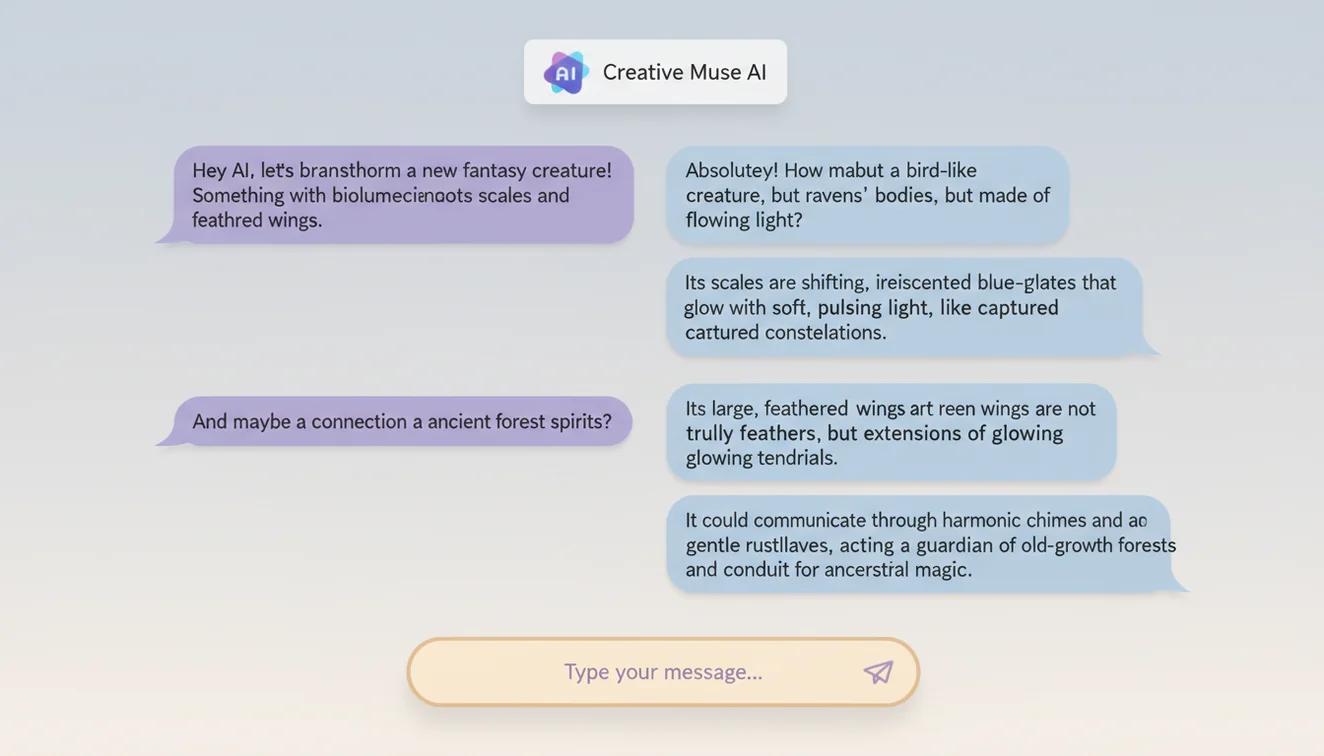
Creative use cases are underrated. AI chatting can help you develop fictional characters, workshop dialogue, generate plot alternatives, or roleplay scenarios for training purposes. Developers use it to rubber-duck debug at 2am. Students use it to get a concept re-explained in simpler terms than their professor managed. Small business owners use it to draft everything from product descriptions to investor updates. The recurring theme across all of these: AI chatting gives you something to react to. Editing a draft is always easier than facing a blank page. For polished long-form output, AI Chat and ChatGOT's full tool suite go further.
Limitations of AI Chatting
AI chatting hallucinates. That's the technical term for when it generates text that sounds completely confident but is factually wrong - invented studies, misattributed quotes, fictional events described with specific dates and details. This happens because the model optimizes for plausibility, not truth. It has no built-in fact-checking mechanism. For casual conversation, the risk is low. For anything where being wrong matters - medical, legal, financial - verify independently. Every time.
Other practical limits: the model's training data has a cutoff date, so it can't discuss very recent events. It doesn't browse the internet in real time. Biases from training data surface in subtle ways - certain viewpoints overrepresented, certain communities underrepresented. And the AI doesn't truly understand what it's saying. It's a very sophisticated pattern matcher, which produces remarkable results most of the time and spectacular failures some of the time. Knowing the difference is on you.
The Social Side of AI Chatting
One underappreciated aspect of AI chatting is how it changes the way people process ideas socially. Talking through a problem - even with a non-human - forces you to articulate thoughts you'd otherwise leave vague. Rubber-duck debugging works because explaining the bug out loud makes the solution obvious. AI chatting extends that principle to every domain: relationships, career decisions, creative blocks, philosophical questions you'd never bring up at dinner. The AI doesn't need to be wise. It just needs to hold the conversational space long enough for you to think clearly.
Getting Better Conversations From AI
Conversation quality with AI scales directly with input quality. Vague prompts produce vague answers. If you ask "tell me about history," you'll get a textbook summary nobody needs. If you ask "what were the three most consequential decisions during the Cuban Missile Crisis, and why do historians still argue about them," you get something worth reading. Set the tone explicitly - "explain this like I'm a tired grad student" works differently than "explain this for a board presentation." Treat the AI like a smart colleague who has no context about your situation, and front-load the details that matter.
AI Chatting App
ChatGOT is available as a free web tool and as a native iOS app with unlimited AI chatting. The app delivers faster response times, offline conversation history, and access to every tool on the platform - including image generation, AI detection, and document analysis. If chatting with AI is part of your daily rhythm, the app makes it frictionless. Download the AI Chat app to take it everywhere.