
Dedicated AI Checker vs Asking a Chatbot to Check Text
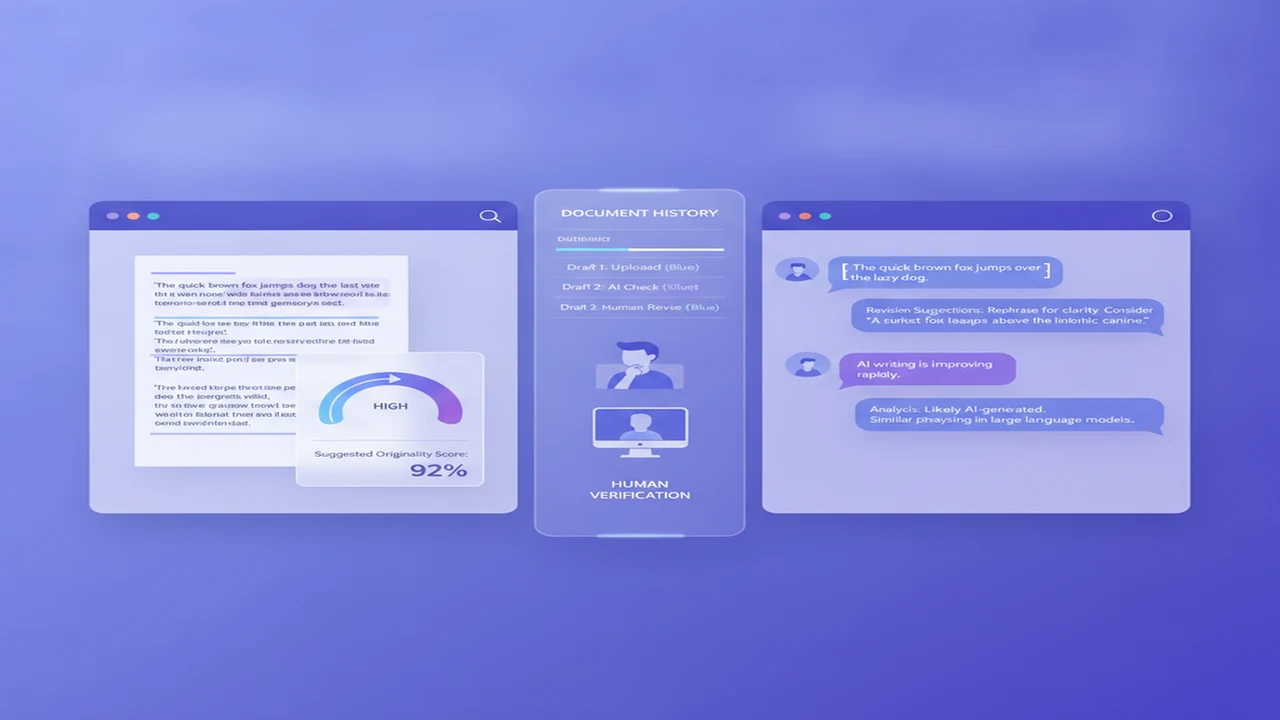
Pasting an essay into AI Chat and asking, “Did AI write this?” feels easier than opening another tool. The response may sound persuasive because a chatbot can discuss repetition, tone, sentence structure, and generic phrasing in plain language. The problem is that a confident explanation is not the same as a reliable authorship classification.
A dedicated checker offers a more structured screen, but its percentage is still an estimate rather than proof. The strongest workflow separates three jobs: use a checker to identify patterns, use AI chat to interpret or revise the writing, and use drafts, citations, metadata, and human judgment to verify what actually happened.
Quick answer: Use a dedicated AI Checker when you need a purpose-built score, highlighted passages, or a repeatable review interface. Use an AI chatbot for explanations, editing suggestions, and comparisons across models. Neither method can prove authorship from text alone, so check results against source history, document revisions, citations, metadata, and human review.
What is the real difference between an AI checker and a chatbot?
A dedicated checker is built around classification. Its interface usually asks for text, processes that text through one or more detection systems, and returns a probability, category, or passage-level signal. Products such as GPTZero, Originality.ai, Copyleaks, Winston AI, QuillBot, and Scribbr illustrate this tool category, although their methods and reporting formats differ.
An AI Chatbot is designed primarily to generate, transform, and explain language. When asked to detect AI-generated writing, it may identify observable characteristics such as predictable transitions, uniform sentence lengths, unsupported generalizations, or repeated structures. Unless the service documents a specialized detector behind that response, the conversation should be understood as a stylistic critique rather than a formal detection result.
This distinction changes the question you should ask. A checker answers something close to “How strongly does this sample match the system’s learned AI patterns?” A chatbot is better suited to “What features of this sample look formulaic, and what other explanations could account for them?” Neither answer establishes who typed or edited the document.
What does a dedicated AI checker add to the workflow?
A purpose-built interface makes screening more repeatable. You can submit documents through the same input process, retain the same output format, and review flagged sections rather than relying on a different conversational response each time. Depending on the service, the result may include an overall probability, sentence-level indications, or a report suitable for later review.
The web-based AI Detector is an example of the dedicated route. Its role in a chat-first workflow is not to issue a final authorship judgment. It is to provide a structured signal that can guide closer reading and follow-up questions.
Structured output is particularly useful when several documents must be screened consistently. It also makes disagreements easier to locate. If one passage receives a stronger signal than the rest, a reviewer can examine whether it contains copied boilerplate, translated material, technical language, heavy editing, or a genuine change in writing history.
Do not convert a percentage directly into a claim about a writer. A score reflects the tool’s model, thresholds, and available text. It does not reveal who drafted the passage, which tools were used, or whether a human extensively revised an AI-assisted draft.
What can an AI chatbot do better with the same text?
Conversation is more flexible than a detector report. You can ask the AI Assistant to quote repetitive sentences, explain why the prose feels generic, compare two revisions, identify unsupported citations, or suggest questions for the writer. You can then challenge its reasoning without starting a separate review.
The mobile AI Writer offers the conversational side of this workflow. A user can bring a passage into AI Chat, request a neutral style analysis, and then ask for a clearer revision. This is useful when the goal is improving writing rather than classifying its origin.
A chatbot also helps separate weak indicators from stronger document evidence. Polished grammar, balanced paragraphs, and predictable transitions can appear in human writing. The model can be prompted to list alternative explanations, identify what it cannot know, and propose verification steps outside the conversation.
Its weakness is consistency. Small prompt changes can affect the answer, and a fluent model may invent certainty. Save the prompt, model name, date, and response if you want to compare later results.
How should you prompt a chatbot to check AI-generated writing?
Avoid the bare prompt “Was this written by AI?” It invites an unsupported binary answer. Give the chatbot a narrower role: analyze visible writing characteristics, quote evidence, explain uncertainty, and recommend checks that do not depend on its intuition.
A useful prompt is: “Analyze this text for observable features sometimes associated with generated or formulaic writing. Do not claim to know the author or tool. Quote each relevant passage, explain the feature, give plausible human explanations, and list the document evidence needed to investigate further.”
For revision work, run detection and rewriting as separate stages. First preserve the original analysis. Then ask for specific improvements such as more concrete evidence, varied sentence structure, clearer attribution, or removal of unsupported claims. This prevents a rewriting request from being mistaken for an authorship assessment.
- Paste a representative text sample without personal or confidential information.
- Ask for observable writing signals rather than a binary authorship claim.
- Require quoted examples and explanations for each observation.
- Repeat the same prompt in a second AI model.
- Run a dedicated AI content detector when structured screening is useful.
- Compare disagreements with drafts, citations, metadata, and revision history.
- Record uncertainty instead of converting a score into proof.
Which option fits each text-checking task?
The right choice depends on the job. AI Detector App represents the structured screening path, while AI Writer & AI Chat: ACI represents conversational analysis and rewriting. The table separates what each category generally contributes without assuming that every product includes every possible feature.
For a fast initial screen, the dedicated interface is usually more direct. For interpretation, follow-up questions, and revision, conversation is more useful. A high-stakes decision requires evidence outside both systems.
How can multiple AI models improve the review?
Run the same neutral prompt in two or more chatbots without telling the later model what the earlier model concluded. Record quoted passages, explanations, confidence language, and proposed verification steps. This exposes disagreements that a single polished answer can hide.
Agreement is useful for prioritizing passages, but it is not independent proof. General-purpose models may share training patterns and assumptions. If several models call a paragraph formulaic, the responsible next step is to inspect the paragraph and its writing history rather than tally chatbot votes.
You can also compare how chatbot detection judgments work before relying on a multi-model consensus. The most useful comparison asks whether models found the same observable signals and whether their alternative explanations make sense.
Finish outside chat. Compare drafts, tracked changes, timestamps, cited sources, assignment instructions, document metadata, and earlier samples from the same writer. These records can address provenance in ways that language patterns cannot.
Where do AI detectors and chatbot judgments fall short?
When should you leave chat for a dedicated checker?
Stay in conversation when you need an explanation, a critique of suspiciously generic phrasing, a comparison between drafts, or revision suggestions. Leave chat for a dedicated checker when you need standardized inputs, a focused screening result, passage-level review where offered, or a consistent interface across several documents.
Use both only when each adds a distinct step. A sensible sequence is checker for triage, chatbot for interpretation, and document evidence for verification. Running many tools until one produces the desired answer creates confirmation bias rather than confidence.
For consequential academic, employment, disciplinary, or publishing decisions, neither route is sufficient alone. Follow a process that lets the writer respond and that examines provenance. Our guide to checking and rewriting AI text in one workflow covers the editing stage without turning stylistic improvement into an authorship claim.
Comparison
| Task | Dedicated AI Checker | AI Chatbot | Best verification step |
|---|---|---|---|
| Fast initial screening | Purpose-built input and classification output | Convenient, but may provide unsupported certainty | Review the sample in context |
| Passage-level pattern review | May flag sentences or segments when supported | Can quote passages when explicitly prompted | Compare flags with drafts and source material |
| Explanation in plain language | Often limited to labels, scores, or brief indicators | Strong at follow-up explanations and alternative interpretations | Ask a human reviewer to assess the explanation |
| Revision and rewriting help | Secondary to the screening task | Can propose targeted edits and compare versions | Preserve the original and verify factual claims |
| Repeatable checks across documents | More standardized interface and output | Requires a saved prompt and model record | Keep dates, settings, versions, and reports |
| Multi-model comparison | May use multiple systems internally, depending on the service | Easy to repeat across separate chat models | Record disagreements instead of averaging opinions |
| High-stakes authorship decision | Provides a signal, not proof | Provides interpretation, not proof | Use revision history, metadata, sources, policy, and human review |
Limitations
Detection results are probabilistic. Human work can be flagged, while edited, translated, mixed-origin, technical, formulaic, or very short text may produce weak or misleading signals. A chatbot can also make a confident authorship inference despite lacking a documented detection capability.
The evidence shows why a single number is unsafe. A Springer study published in 2024 found that all evaluated tools scored below 80% accuracy and only five exceeded 70%. Those are two benchmark findings from one study, not universal performance guarantees for every detector or text type.
A 2024 medical-education study reported sensitivities ranging from 0% to 100% across 10 free detectors. That range demonstrates how strongly results can depend on the selected tool, sample, threshold, and balance between catching generated text and avoiding false positives.
Privacy is another constraint. Do not upload confidential student, client, employee, unpublished, or personally identifying text without checking the service’s policies and your organization’s rules. AI Humanizer features may alter style, but they cannot establish originality, factual accuracy, appropriate attribution, or required disclosure. Detector behavior can also change as models, data, and product systems are updated.
Frequently Asked Questions
Can any tool reliably prove that text was written by AI?
No. A detector can estimate whether text resembles patterns associated with generated writing, but it cannot identify the author or reconstruct the drafting process. Proof requires supporting evidence such as revision history, source records, metadata, and an opportunity for the writer to explain the work.
Can a chatbot check if text is AI-generated?
A chatbot can discuss features associated with formulaic or generated prose, but that does not mean it is running a specialized detector. Ask for quoted observations, alternative explanations, and uncertainty rather than a yes-or-no judgment.
Why might different AI detectors return different results?
Detectors can use different models, training data, thresholds, segment rules, and definitions of AI-like writing. Results also change with text length, editing, translation, subject matter, and mixed human-AI drafting.
Is an AI Humanizer the same as an originality checker?
No. A humanizer rewrites style or phrasing, while an originality or detection tool evaluates a submitted sample according to its own criteria. Rewriting does not prove human authorship, factual accuracy, originality, or proper disclosure.
Should confidential writing be pasted into an AI Checker or AI Chat?
Only after reviewing the service’s privacy terms and the rules governing the document. Remove identifying details where possible, and do not upload protected student, workplace, client, medical, or unpublished material without authorization.
Does AI Detector App explain why a passage may be flagged?
Public listings should be checked for the current output and reporting features because interfaces can change. Regardless of the format, any score or highlighted passage should be reviewed as a screening signal rather than proof of authorship.
When is AI Writer & AI Chat: ACI more useful than a dedicated detector?
It is better suited to conversational tasks such as asking follow-up questions, comparing versions, identifying generic phrasing, and requesting targeted revisions. A dedicated detector is the more focused choice when standardized screening is the primary task.