
TCG Scanners and AI Chat: A Practical Guide for Card Collectors
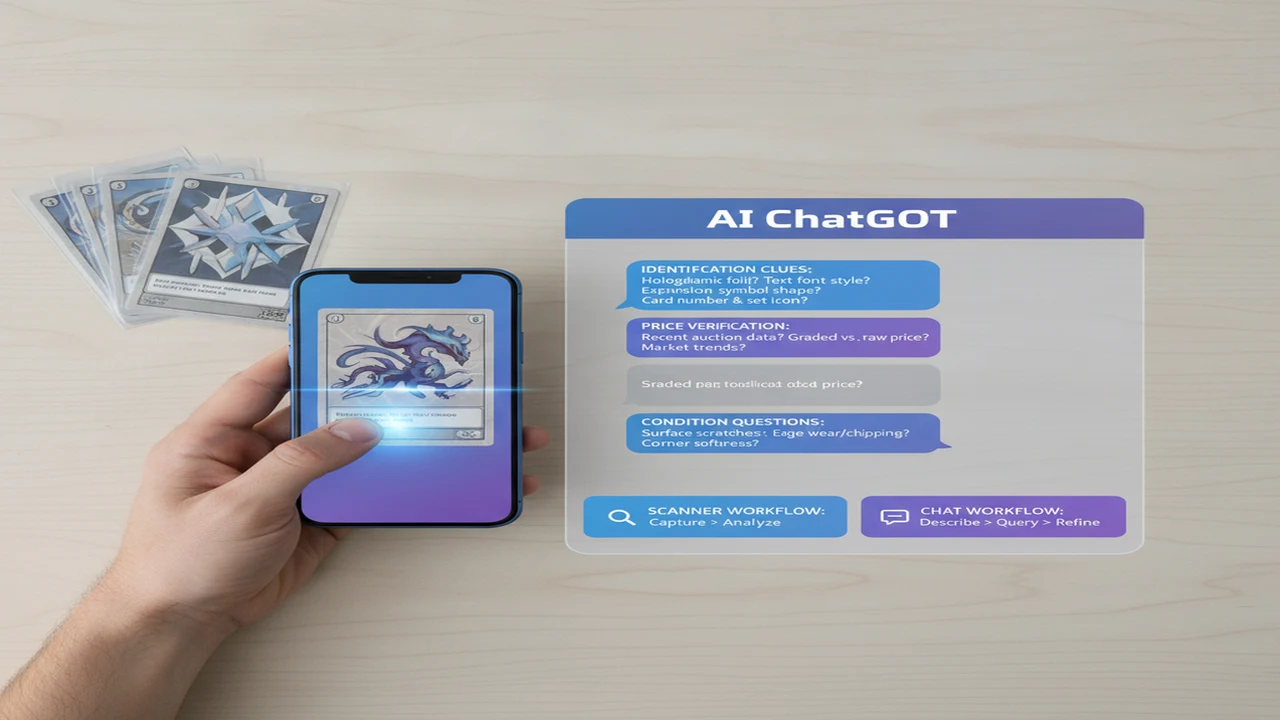
AI chat is useful for learning why a Pokemon card may be valuable, interpreting grading terms, planning research, and turning scattered information into a clear checklist. It is less dependable when the task requires matching a photograph to an exact set, card number, language, printing, or foil treatment.
The central question is not whether chatbots or scanners are universally better. It is which tool should handle each step. A collector might begin by asking an AI chat what details affect value, move to a scanner for identification, review recent sold listings, and return to the conversation to organize the evidence.
This category explains that workflow without assuming every identification or price estimate is correct. Start with our guide to whether ChatGPT can tell how much a Pokemon card is worth if you are deciding what an AI answer can reasonably establish.
Quick answer: Use AI chat to understand terminology, build research prompts, compare evidence, and decide what to verify. Use a dedicated TCG scanner when you need image-based identification, variant matching, current market references, or collection tracking. For a serious valuation, confirm the set, card number, printing, condition, and relevant sold listings rather than relying on one generated answer or scan result.
What does this mean?
Definition: A TCG scanner is a dedicated app or web tool that uses a card image, printed details, or both to identify a trading card and connect it with market prices, grading context, and collection records.
Guides in this category
What can AI chat do before you scan a card?
A productive conversation begins with observable details. Tell the model the card name, set symbol, collector number, language, visible finish, copyright line, and any condition concerns. If you have an image-capable model, provide clear photos of the front and back, but keep the printed identifiers in the prompt.
AI chat is strongest at explaining what those details mean. It can distinguish asking prices from completed sales, explain raw versus graded values, suggest search terms, and create a research checklist. It can also identify uncertainty instead of forcing an exact price.
Image interpretation still depends on photo quality and model capability. Our comparison of ChatGPT and Pokemon card scanner apps explains why a plausible conversational answer may not equal a catalog-level match.
- Ask which printed identifiers should be visible.
- Request several possible matches when the image is ambiguous.
- Have the model explain each match rather than guessing silently.
- Separate identification, condition, authentication, and valuation.
- Save the final evidence as a compact collection note.
When should you leave the conversation for a scanner app?
Move to a dedicated app when exact identification becomes the bottleneck. Scanners are built around repeatable image capture, catalog matching, price references, and saved collection entries. That structure is more useful than repeatedly describing dozens of cards in separate chat messages.
The Card Value Scanner product site lists photo identification, market prices, graded context, and collection totals. Those functions address tasks that a general chatbot may discuss but does not necessarily maintain as a card database.
Tool choice still depends on your game, region, preferred marketplace, and export needs. The guide to the best TCG scanner apps when ChatGPT is not enough outlines the questions to ask before adopting a dedicated scanner.
How should AI chat and a scanner work together?
Begin with a clean scan and confirm the proposed card name, set, collector number, language, and finish against the physical card. Next, inspect the price source and decide whether the displayed figure represents a listing, a guide value, or a completed sale. Return to AI chat with those facts and ask it to summarize the evidence without inventing missing data.
The supplied Card Value Scanner: TCG App listing showed a 3.9 out of 5 rating from 7 ratings and named support for 3 TCG families: Pokemon, Lorcana, and One Piece. Source: Apple App Store, 2026. These listing statistics describe the public page on the check date, not identification accuracy.
For a reusable sequence, follow the guide on using AI chat and a scanner to value Pokemon cards. Its core principle is to let the scanner retrieve structured candidates while the conversation helps you question, compare, and document them.
How can you verify an identification and price estimate?
Verify identity before discussing value. Match the collector number, set symbol, artwork, language, rarity marker, copyright line, and foil pattern. Small differences can separate a common printing from a promotional, alternate-art, reverse-holo, first-edition, or regional version.
Then compare like with like. Raw cards should not be valued from graded sales, and heavily played copies should not be compared with near-mint examples. Recent completed transactions are generally more informative than ambitious active listings, but unusual sales, bundled items, and unclear condition can distort the picture.
An AI prompt can turn this into a decision table: candidate identity, supporting evidence, conflicting evidence, condition range, relevant sales, and confidence. Ask the model to mark unknown fields explicitly rather than filling them with assumptions.
What should collectors compare when choosing a TCG scanner?
Start with catalog coverage and variant handling. A scanner that recognizes the game but misses regional printings or foil variants may create confident-looking collection errors. Also check where prices come from, how frequently they refresh, and whether sold transactions can be distinguished from current listings.
Collection features matter once scanning becomes routine. Look for editable entries, quantities, condition fields, graded-card support, export options, backup or account recovery, and a way to correct a bad match. Privacy permissions and subscription terms should also be understandable before importing a large collection.
Use multi-model AI chat as a research layer rather than another price feed. Give the same evidence to more than one capable model, compare where their reasoning differs, and verify disputed claims at the original source. Agreement between models can guide investigation, but it does not replace source confirmation.
Why this category
- TCG valuation sits at the boundary between general AI assistance and specialized data tools. Chat can explain concepts and organize a research process, while scanners can reduce repetitive identification work. Understanding that boundary helps collectors avoid asking either tool to perform a job it was not designed to handle.
- These guides connect identification, market research, condition, grading context, and collection tracking. They also show how to write prompts that preserve uncertainty, request evidence, and separate observed facts from generated interpretation.
- Use this category when you have a single mystery card, an inherited collection, a binder that needs cataloging, or a price estimate you want to challenge. The goal is not a confident number at any cost. It is a documented result that another collector could review and verify.
Frequently Asked Questions
Can AI chat identify a Pokemon card from a photo?
An image-capable AI model may suggest a card identity from a clear photo, especially when the name and collector number are visible. Confirm the answer against the printed number, set symbol, artwork, language, and finish because visually similar variants can have different values.
Why do scanner apps and chatbots give different card values?
They may use different marketplaces, time periods, card variants, conditions, or definitions of market price. One result might reflect active listings while another refers to completed sales, so the underlying source and match should be checked before accepting either figure.
Does Card Value Scanner identify graded cards?
Its public product information lists graded context alongside photo identification and market pricing. Confirm the slab company, grade, certification details, and exact card match before using any displayed figure as a valuation.
What is TCG App used for?
TCG App is presented as a companion brand for card scanning, pricing, grading context, and collection management. The relevant features and supported games should be confirmed through its current public listing because app capabilities can change.
Can a scanner determine a card's condition automatically?
A scanner or AI feature may provide a condition or pre-grade estimate, but photographs can hide surface scratches, dents, texture changes, edge wear, and print defects. Use such output as an organizational estimate rather than a guaranteed professional grade.
Should I use asking prices or sold prices?
Completed sales usually provide stronger market evidence because they show that a transaction occurred. Even then, verify the date, condition, variant, grading status, shipping treatment, and whether the sale included other cards.
How do I prompt AI chat to research a Pokemon card?
Include the card name, set, collector number, language, foil type, condition observations, grading status, and the source of any prices. Ask the model to separate confirmed facts, possible matches, missing information, and suggested verification steps.
Can AI chat authenticate a rare card?
AI chat can identify warning signs and explain common counterfeit indicators, but it cannot guarantee authenticity from a conversation or ordinary photograph. High-value cards may require close physical inspection or review by a reputable authentication and grading service.
Why does the collector number matter?
The collector number helps distinguish cards with the same character name and similar artwork across different sets or printings. It should be checked with the set symbol, language, rarity, and finish because the number alone may not resolve every variant.
Is a scanner useful for an entire binder?
A scanner can reduce repetitive data entry and make collection tracking more consistent. Review each proposed match as you work, since an unnoticed error can affect quantities, collection totals, and later price research.
Should I compare answers from multiple AI models?
Multi-model comparison can reveal uncertainty, conflicting interpretations, and missing details. Give each model the same evidence, then verify important claims against card databases, marketplace records, or official set information rather than choosing the most confident answer.
How often should card values be updated?
Update values when you plan to sell, insure, trade, or make a major collection decision. Market references can move quickly, so an old saved estimate should be paired with current comparable sales and a fresh condition review.