
How to Use AI Chat and a Scanner to Value Pokemon Cards
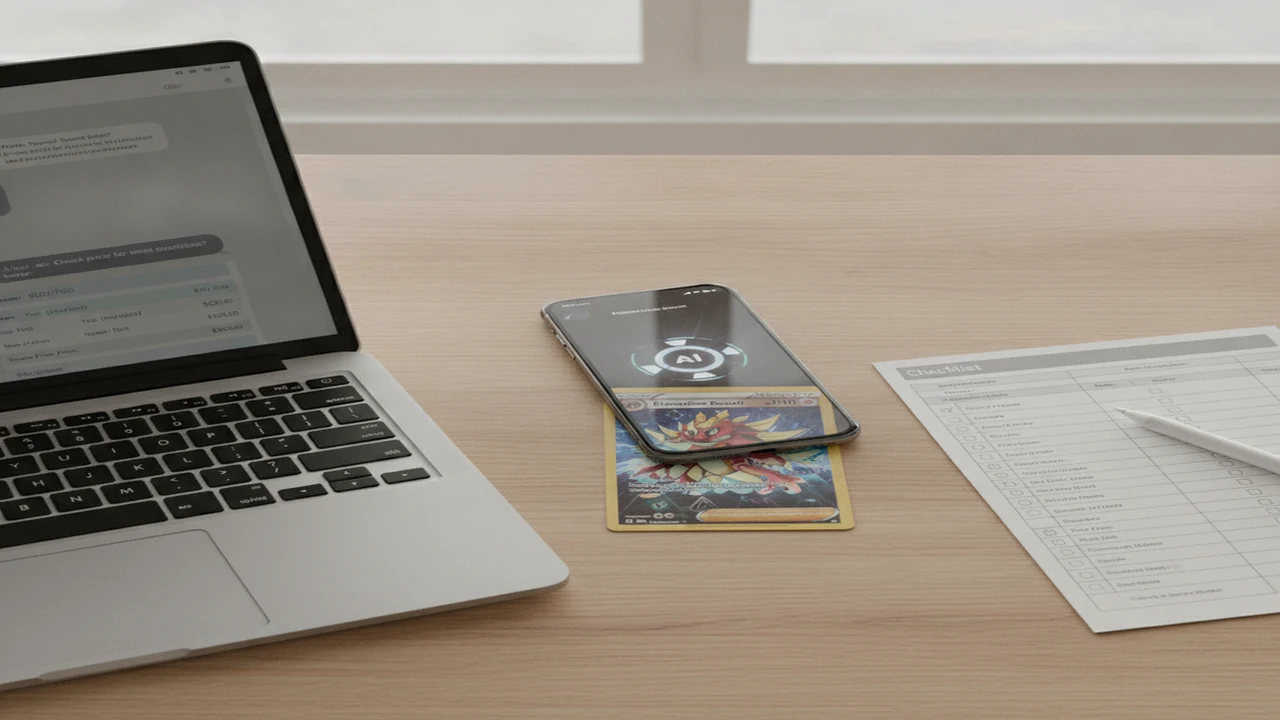
The question “how much is my Pokemon card worth?” sounds simple, but a reliable answer depends on identification, variant, condition, grading status and recent comparable sales. A chatbot can explain those factors, yet it may misread a photograph or recall an outdated price. A scanner can identify a likely catalog entry quickly, but its estimate still needs context.
The category is already large enough for Shiny to claim more than 1 million Pokemon card and TCG collectors on its 2026 app listing. That popularity does not make every scan conclusive. The more defensible workflow assigns different jobs to chat, scanning and manual verification instead of expecting one tool to settle the value.
Quick answer: Use AI chat to build an identification checklist, interpret price data and compare possible variants. Then use a Pokemon card scanner for camera identification, current market references and collection tracking. Confirm the exact set, collector number, edition, finish, condition and grading status before estimating value. Chat guides the research, while scanner data and completed sales provide the stronger pricing foundation.
What information do you need before asking AI about a Pokemon card?
Start with evidence the model can organize. Photograph the entire front and back in bright, indirect light. Add angled images if the foil pattern, texture or surface wear is difficult to see. Avoid sleeves, glare and cropped corners where possible.
Record what you can read without guessing. The card name alone is insufficient because the same artwork or character can appear in multiple sets, promos, reprints and finishes. If the card is graded, include the grading company, numerical grade and certification number.
- Card name, language and readable attack or rule text
- Set symbol, collector number and total set number
- Edition, promo, rarity and copyright markers
- Holo, reverse holo, textured or other finish
- Front and back wear, including creases or whitening
- Professional grading company and grade, if applicable
How should you scan and identify the exact Pokemon card?
Use the camera scan to generate a likely match, then compare the returned image, set name, number, rarity and finish with the physical card. A scanner result is a search shortcut, not the final identity. Manually correct the result if the app selects a visually similar printing.
A dedicated option such as Card Value Scanner combines photo identification with market prices, graded context and collection totals. That makes it more suitable than general AI chat when you need instant camera card identification or want to retain the result in a portfolio.
Pay particular attention to cards sharing artwork across a base set, promotional release or later reprint. If the number or set symbol differs, stop the valuation process and resolve the identity first.
What prompt should you use to research the card in AI chat?
Give the model structured facts rather than asking for a price from an unexplained photograph. The prompt should force a separation between observations, inferences and missing evidence.
Use this prompt: “I am researching a Pokemon card. Observed details: [name, set symbol, collector number, language, edition markers, finish, condition and grading status]. Separate observed facts from assumptions. List plausible variants, explain what distinguishes them, identify missing details and create a verification checklist. Do not estimate value until the exact version is confirmed. When discussing prices, separate completed sales from active listings and raw cards from each grading company.”
For dedicated TCG research and saved card information, TCG App provides a companion route instead of depending on a model’s memory. Paste confirmed scanner details back into the conversation and ask AI to explain why specific comparables are relevant.
How can multi-model AI chat reduce identification mistakes?
Ask two AI models to analyze the same written identifiers independently. Do not show the second model the first answer, because that can encourage agreement rather than a fresh analysis. Compare the proposed set, collector number, finish and release type afterward.
If the models disagree, ask each one to name the visible evidence that would resolve the difference. Then return to the scan, card photograph or Pokemon card database. Our guide to how ChatGPT and Pokemon card scanners handle identification explains why visual matching and conversational reasoning fail in different ways.
Scale is not the same as certainty. PokéScope reported reaching 50,000 users in 2025, illustrating demand for scan-first research. Expensive or unusual cards still merit confirmation from another model or data source.
How do you compare raw, PSA, CGC and BGS card values?
Separate ungraded cards from graded cards before calculating a range. A raw near-mint sale is not a substitute for PSA graded card values, and a PSA 10 sale should not be averaged with a lower grade. CGC graded card values and BGS graded card values also belong in their own groups.
Match the grading company, numerical grade, card variant and sale period. Certification populations, label generations and subgrades can affect buyer behavior, but AI should not invent a premium without supporting sales.
If you own a raw card, graded prices can show potential upside, not its present value. Deduct grading costs, selling fees, shipping, processing time and the risk of receiving a lower grade before considering whether submission makes financial sense.
How do you verify sold prices instead of asking AI to guess?
Collect completed transactions for the confirmed version. Real eBay sold card prices can be useful when the listing photos and sale details are visible. A TCGPlayer price comparison or Cardmarket price comparison may provide additional market context when those sources cover the card and region.
Ask AI to organize evidence by sale date, variant, raw condition, grading company, grade and venue. Exclude active asking prices from the completed-sales calculation. Also flag lots, autographed cards, authenticated altered cards and listings with unclear photographs.
Use our process for fact-checking an AI-generated Pokemon card valuation when a chatbot presents a precise number without dated evidence. A reasonable response should show how its range was assembled rather than asking you to trust a remembered market figure.
How should condition affect the estimated value?
Review centering, corners, edges and surfaces separately. Look for whitening, scratches, dents, creases, print lines, stains, peeling and binder impressions. Capture angled light across both faces because a straight-on photo can hide indentations and surface damage.
An AI card grading app or Pokemon card grading app can provide preliminary guidance, but its output is not professional authentication or a guaranteed grade. CardGrade says its CGI Vision AI examines 47 inspection points for condition analysis in 2026. Even a detailed AI card pre-grading process may miss alterations or defects that are not visible in the submitted images.
For valuation, describe the observable condition and calculate a conservative range. Do not label a raw card “PSA 10” merely because it looks clean through a phone camera.
When should you leave AI chat for a dedicated scanner or tracker?
Move out of chat when visual identity remains uncertain, you need live TCG price checks, or you are processing enough cards that repeated manual prompts become inefficient. Multi-card scanning, Pokemon card price alerts, portfolio totals and recurring collection updates are dedicated app jobs.
ScanDex provides a Pokemon-focused context with recognition, market trends, rarity and condition data, collection tools and a personal wishlist. Card Value Scanner for Pokemon (App All Day) focuses on card details, price monitoring and a watchlist across base set through modern sets. Public listings should be checked for the exact workflow you need.
The broader guide to when a dedicated app beats general AI chat covers scanner selection in more depth. In this workflow, return to conversation after scanning when you want help interpreting contradictory prices, planning verification or documenting assumptions.
How do you record a defensible value range?
Record low, typical and high estimates rather than one authoritative number. Tie the low figure to conservative condition assumptions or weaker recent comparables, the typical figure to the closest confirmed sales, and the high figure to stronger condition without crossing into an unsupported grade.
Save the valuation date, card identity, finish, condition notes, comparable-sale URLs or screenshots, venue, currency, shipping treatment and likely selling fees. A Pokemon card price tracker or Pokemon card portfolio tracker should preserve enough context to explain later changes in Pokemon card price history.
- Photograph the card clearly
- Record visible identifiers
- Scan the card for a likely match
- Confirm the set and variant
- Prompt AI with structured facts
- Compare answers across AI models
- Verify recent comparable sales
- Separate raw and graded prices
- Adjust for observable condition
- Save a dated value range
Comparison
| Workflow stage | Use AI chat for | Use a scanner or dedicated app for | Verification question |
|---|---|---|---|
| Initial identification | Build a checklist from visible text and symbols | Use Card Value Scanner for a likely camera match | Do the image, set and collector number all match? |
| Variant research | Explain differences among promos, reprints and finishes | Consult catalog records in TCG App | Is this the exact edition and foil treatment? |
| Condition review | Organize observed defects and assumptions | Store clear front, back and angled images | Which defects are visible, and which remain unknown? |
| Raw price lookup | Sort comparables and exclude mismatches | Retrieve current market references | Are these completed sales for the same raw condition? |
| Graded price comparison | Separate companies, grades and sale dates | Surface grade-specific pricing context | Do company, grade, variant and date match? |
| Collection tracking | Explain changes and prepare update prompts | Maintain totals, history and repeated scans | When was each tracked value last refreshed? |
Limitations
What can go wrong in a chat-and-scan valuation workflow? Image recognition can select a similar card, parallel or reprint, while AI chat can rely on stale knowledge, confuse asking prices with completed sales or produce unsupported market figures. Rare variants and subtle foil differences are especially vulnerable to single-pass identification errors.
Photo-based condition guidance cannot reveal every defect, alteration or authenticity issue. Raw, PSA, CGC and BGS results are not interchangeable when grades or sale dates differ. Marketplace records may also omit fees, shipping, canceled transactions or unusual buyer behavior, so retain the underlying evidence and assumptions behind the range.
Frequently Asked Questions
Can AI tell how much a Pokemon card is worth from one photo?
It can suggest an identity and explain pricing factors, but one photo rarely proves the exact variant, condition or authenticity. Confirm the set, collector number, finish and recent completed sales before recording a value.
Is Card Value Scanner an AI card grading app?
Card Value Scanner is positioned around photo identification, market prices, graded context and collection totals. Photo-based condition information should be used as preliminary guidance rather than a substitute for professional grading or authentication.
Can TCG App replace manual sold-price research?
No dedicated research app removes the need to inspect important comparables. TCG App can support card research and organization, while higher-value decisions should still check sale date, exact variant, condition, grade and transaction type.
What is the difference between a Pokemon card price checker and a price tracker?
A Pokemon card price checker returns a current reference for a card. A Pokemon card price tracker stores values over time, helping you monitor market movement, portfolio totals and possible price alerts.
Should I use raw prices or PSA graded card values?
Use raw comparables when valuing an ungraded card in its present condition. PSA graded card values are relevant only when the card is already graded or when cautiously evaluating possible submission economics.
How recent should comparable Pokemon card sales be?
Use the newest relevant sales that provide a meaningful sample, particularly in a fast-moving market. Expand the date range when the card is scarce, but note that older transactions may no longer represent current demand.
Can a Pokemon card scanner identify reprints and parallel variants?
A scanner may propose the correct printing, but similar artwork and subtle foil differences can cause mismatches. Verify the set symbol, collector number, copyright line, finish, rarity and promotional markers manually.
What information should I save in a Pokemon card portfolio tracker?
Save the exact card identity, variant, quantity, raw or graded status, condition notes, acquisition cost, scan images, valuation range, evidence date, comparable sales and any fees assumed in the estimate.