
ChatGPT vs Pokemon Card Scanner Apps for Identification
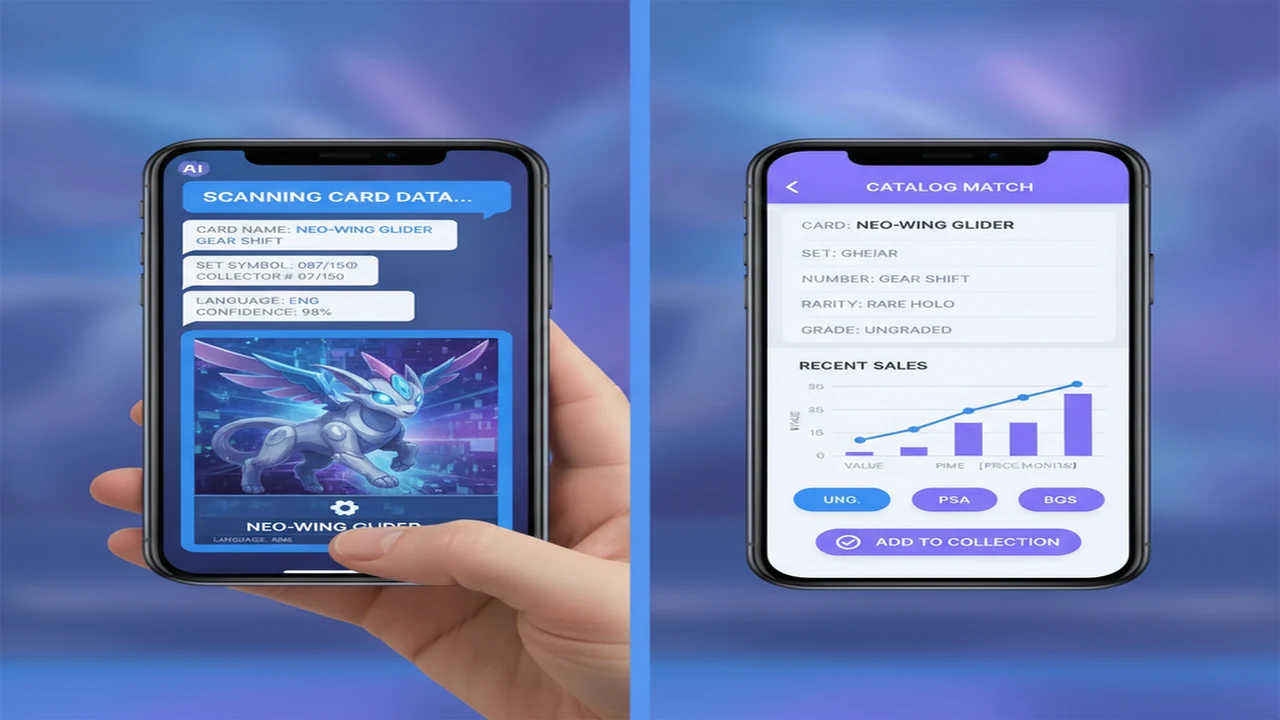
Showing a Pokemon card to ChatGPT feels like the fastest way to answer a simple question: what card is this? AI chat can read visible text, reason through artwork and explain why a set symbol matters. It is especially helpful when the card is damaged, unfamiliar or partly obscured and you need an interactive research partner.
Identification becomes harder when visually similar printings, foil treatments, promos and reprints enter the conversation. At that point, confidence is less useful than structured confirmation. A dedicated scanner can match catalog records and organize results, while chat remains valuable for examining uncertainty and deciding what to verify next.
Quick answer: ChatGPT can inspect a card photo, explain visible clues and suggest follow-up research, but it may misread sets, variants or condition. A dedicated Pokemon card scanner app is generally better for structured catalog matching, current price evidence and collection tracking. The strongest workflow uses AI chat for reasoning and verification, then a scanner app for confirmed identification and market data.
What can ChatGPT identify from a Pokemon card photo?
An AI chat can usually extract the card name, visible collector number, language, artwork description and possible set symbol from a clear photograph. It can also ask for the back, a closer image of the numbering line or a tilted photo that reveals the foil pattern.
Conversational reasoning is the main advantage. If part of the card is hidden, the model can form several candidates and explain which printed detail would separate them. This is more flexible than receiving one scanner result without an explanation.
A reusable prompt is: “Inspect this Pokemon card image. Extract the exact name, collector number, set symbol, language, copyright line and visible foil treatment. List up to three possible catalog matches, explain what supports each match and state which details remain uncertain. Do not estimate value until the variant is confirmed.”
For more context on building an image-based prompt, see how to ask AI about an image. Asking for extracted fields rather than an instant conclusion makes it easier to notice when the model has guessed a number or confused similar artwork.
A 2025 Pokemon card recognition comparison from NeoSatoshi also illustrates why identification accuracy and workflow speed should be considered separately. Chat can be useful as a first pass without being the most efficient option for processing a large stack.
When should you switch from AI chat to a dedicated card scanner?
Switch when you need a repeatable catalog match rather than a conversational hypothesis. This includes sorting many cards, recording a collection, checking current prices or distinguishing editions that share a name and artwork.
A dedicated option such as Card Value Scanner is designed around photo identification, market prices, graded context and collection totals. That structure reduces the need to copy each result from a conversation into a separate spreadsheet or portfolio.
The switch is also important when someone asks, “how much is my Pokemon card worth?” Identification and valuation are separate jobs. The correct card entry must be established before a Pokemon card price checker can provide useful comparables.
Market research should then distinguish raw cards from professionally graded copies. Active asking prices, recent sold prices, marketplace estimates and PSA graded card values may describe very different markets even when they refer to the same printing.
- Stay in chat when you need clues explained or need help reading a partially obscured card.
- Use a scanner when speed, catalog consistency or multi-card scanning matters.
- Use market sources when the task moves from identification to Pokemon card market value.
- Use graded references when the card is already encapsulated or grading is a realistic next step.
How can chat and a scanner app work together?
A combined workflow assigns each tool a focused role. AI chat extracts evidence and surfaces ambiguity. The scanner confirms a catalog entry and retrieves structured market information. The conversation can then help interpret price outliers, grading terminology or differences between marketplaces.
For iOS, Card Value Scanner: TCG App lists sold-price evidence, PSA, CGC and BGS context, AI card pre-grading and collection tracking. That makes it relevant after the conversational inspection, particularly when raw and graded values need to be kept separate.
When price evidence looks inconsistent, return to the conversation with the confirmed set, number, variant and condition. Ask the model to organize the evidence rather than invent a value. The guide on how to verify AI-generated price claims covers that research boundary in more detail.
- Photograph the card front and back in even light
- Prompt the AI to extract the name, set symbol, collector number, language and variant
- Compare answers from a second AI model when fields are uncertain
- Scan the card in a dedicated catalog app
- Verify the match against artwork, numbering and set details
- Review sold prices separately from active listings
- Record condition and graded-price context
- Save the confirmed card to a collection tracker
Which approach is better for difficult variants and grading questions?
AI chat is useful when the difficulty requires explanation. It can describe where to look for a promo stamp, compare copyright lines or ask whether the foil appears across the artwork, background or entire card. This reasoning helps with reverse holos, alternate art, reprints and unfamiliar languages.
A scanner database is better at converting those observations into a defined catalog record. The collector should still compare the printed number, set checklist, artwork and variant label because recognition can return a nearby edition.
Condition assessment is a different task from identification. Whitening, scratches, print lines, centering, dents and surface wear cannot be reduced to the card name and set number. Photos may hide defects that become obvious under angled light.
An AI card grading app or AI card pre-grading feature can provide an estimate for sorting and research. It cannot guarantee the grade later assigned by PSA, CGC or BGS, so a PSA card value checker should not be used as if a raw card has already earned that grade.
How do popular Pokemon card scanner apps compare?
The table below is a listing-based TCG scanner app comparison, not an accuracy ranking. The best Pokemon card scanner app depends on whether the collector prioritizes sold-price research, set completion, portfolio history, social features or support for multiple games.
ScanDex emphasizes recognition, price trend charts and a personal wishlist. Acorn TCG Card Scanner combines quick scanning with TCGPlayer market data and portfolio value history. Foloy adds auction price tracking and Magic card support, while Dex combines Pokemon cataloging with a deck builder and collector friends.
Those differences matter because a broad collection manager and a sold-price research tool solve related but distinct problems. A collector should verify the marketplaces, graded references and export or tracking features named in the current listing rather than assuming every scanner handles them in the same way.
How can multiple AI models help verify an identification?
Send the same card images and structured prompt to more than one AI model. Ask each model to return the name, set, number, language and variant in a fixed format, followed by an uncertainty note. A consistent format makes disagreements visible.
Do not select the answer that sounds most confident. Compare disputed fields against the printed collector number, an official or reputable set checklist and the dedicated scanner result. If one model identifies a promo and another identifies a standard-set printing, ask both to name the visual evidence that would settle the dispute.
This habit is useful beyond cards. Learning to compare answers across AI models and dedicated tools helps separate plausible language from evidence that can be checked.
The final record should reflect the confirmed catalog evidence, not a majority vote among chatbots. Several models can repeat the same mistaken assumption when the source image is blurry or when training data favors a more common edition.
- Use identical images and prompts for each model.
- Require every model to state uncertainty and alternative matches.
- Compare individual fields rather than whole answers.
- Confirm the result through numbering, set details and a catalog app.
What are the limitations of chatbots and scanner apps?
Chatbots can infer the wrong set or variant from blurry, reflective or incomplete images. Scanner recognition also requires checking collector numbers, language, foil treatment, promo markings and artwork because a visually close catalog result may not be the exact printing.
Pricing introduces another layer of uncertainty. An active asking price does not establish Pokemon card market value, and marketplace estimates can differ from recent comparable sales. Raw cards, graded cards and cards listed in different regions should not be combined without context.
Condition estimates and AI card pre-grading cannot guarantee PSA, CGC or BGS outcomes. Small surface defects, dents and altered cards may be difficult to judge from ordinary phone photos.
Catalog depth, marketplace coverage and app features can change after the article date. Public listings may also omit supported functions, so an unmentioned feature should not be described as definitively unavailable.
- Poor lighting can hide foil patterns, scratches and set symbols.
- Chat responses may contain invented variants or unsupported prices.
- Scanner databases can return adjacent printings that share artwork.
- Sold prices, asking prices and graded values answer different questions.
- Currency, language, region and marketplace fees can affect comparisons.
- Portfolio totals are estimates that move with the app’s selected data source.
Which identification method should you choose?
For a one-card mystery, start with AI chat. It can read visible clues, explain terminology and tell you what additional photograph would be useful. Confirm the resulting set and variant before asking for a value.
For bulk cataloging or a Pokemon card portfolio tracker, use a dedicated scanner. Structured records, repeatable matching and collection totals are more useful than maintaining a long conversation for every card.
For graded-card research, identify the exact card and then examine grade-specific sold evidence. PSA, CGC and BGS populations and prices should not be substituted for one another without noting the company and grade.
Collectors who repeatedly research prices can use Card Value Scanner as the structured layer while keeping AI chat as the research layer. The conversation is best for questions and interpretation; the scanner is better for catalog matching, live TCG price checks and saved collection records.
Comparison
| Tool | Best identification role | Market-value context | Collection features | Listing-based caution |
|---|---|---|---|---|
| ChatGPT | Conversational photo inspection, clue extraction and follow-up questions | Can organize supplied evidence but is not a dedicated live Pokemon card price checker | Conversation history rather than a structured card portfolio | May misread variants, invent details or rely on outdated information |
| Card Value Scanner: TCG App | Instant camera card identification and catalog confirmation | Lists sold-price evidence plus PSA, CGC and BGS context | Collection tracking and value totals | AI pre-grading remains an estimate, and listing details should be rechecked |
| ScanDex | Pokemon card recognition | Price trend charts | Collection management and personal wishlist | Its listing does not name marketplace sources or graded-price comparisons |
| Acorn TCG Card Scanner | Quick scans with broad catalog and set tracking | TCGPlayer market data | Custom collections and portfolio value history | Its listing does not describe AI pre-grading or CGC and BGS value coverage |
| Foloy | Multi-game scanning with set and rarity sorting | Auction price tracking | Collection value totals and Magic card support | Its listing does not identify specific price providers or graded-value features |
| Dex | Pokemon scanning and multilingual catalog research | General collection-oriented value context | Set statistics, deck builder and collector friends | Its listing does not describe AI grading or sold-only eBay evidence |
Limitations
Frequently Asked Questions
Can an AI chatbot identify a Pokemon card from a photo?
Yes. A chatbot can read the name, collector number, language, artwork and other visible clues from a clear image. Its result should be confirmed against the printed card details and a catalog because visually similar printings can be confused.
Is a Pokemon card scanner more accurate than ChatGPT?
A dedicated scanner is generally better suited to structured catalog matching and processing many cards, while ChatGPT is better at explaining ambiguous clues and asking follow-up questions. Accuracy depends on image quality, catalog coverage and whether the user verifies the proposed variant.
Can Card Value Scanner show PSA, CGC and BGS graded card values?
Its public listings describe PSA, CGC and BGS value context alongside sold-price evidence. Confirm the card, grading company and exact grade before comparing those references with a raw copy.
How can I tell whether a scanned card is a reverse holo, promo or reprint?
Check where the foil appears, look for promo stamps, compare the collector number and inspect copyright or regulation marks. Match those details against the set checklist rather than relying only on shared artwork.
Can AI determine how much my Pokemon card is worth?
AI can help organize comparable sales and explain why prices differ, but it needs a confirmed variant, condition and current market evidence. Separate active asking prices from completed sales and raw values from professionally graded values.
Is an AI card grading app a substitute for professional grading?
No. AI pre-grading can help sort cards and flag visible condition issues, but ordinary photos may miss dents, surface damage or alterations. Only the grading company determines the final grade for a submitted card.
What features matter when choosing the best TCG scanner app?
Look for reliable catalog matching, clear marketplace sources, sold-price history, graded-value context, collection tracking and support for the games you collect. Also consider batch workflow, exports, price alerts and whether the listing explains how condition and variants are handled.