
Can ChatGPT Tell How Much a Pokemon Card Is Worth?
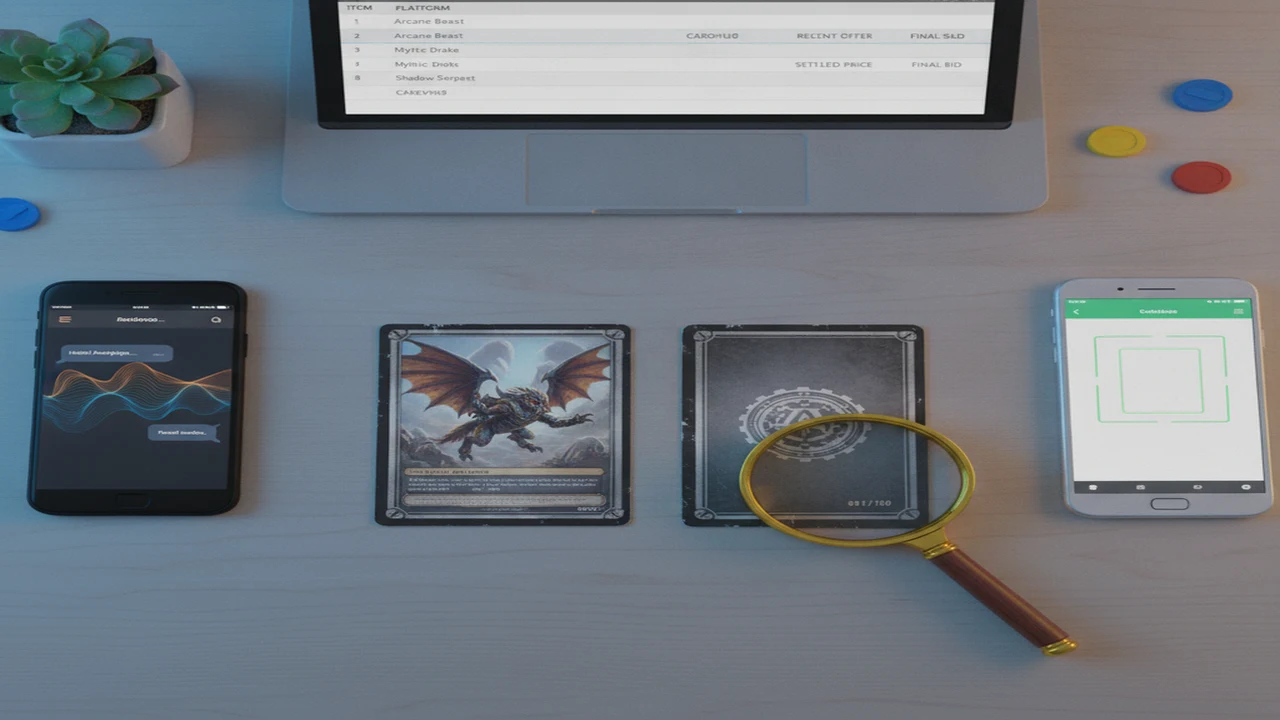
When someone asks, “How much is my Pokemon card worth?”, an AI chatbot can produce a confident-looking answer in seconds. The problem is that a plausible number may refer to the wrong printing, an old market price, an active listing that never sold, or a graded copy when the photographed card is raw.
The more useful role for ChatGPT is conversational research. It can turn a difficult identification into a checklist, explain unfamiliar terminology, generate precise marketplace searches, and challenge weak assumptions. The final price still has to come from matching the exact card with current market evidence.
Quick answer: ChatGPT can help identify a Pokemon card, explain pricing factors, organize marketplace research, and compare evidence. It cannot reliably establish an exact current value from a photo or memory alone. For a defensible estimate, verify the collector number, variant, condition, recent sold listings, and graded-card data, then use a dedicated scanner or marketplace when live pricing matters.
What can ChatGPT actually do when valuing a Pokemon card?
AI chat is best used as a research assistant, not a price authority. Given a clear photograph or detailed description, it can interpret the printed name, collector number, set symbol, rarity mark, language, and edition indicators. It can also explain why holographic treatment, promotional stamps, grading, and condition affect value.
A useful conversation should produce an identification hypothesis and a list of uncertainties. For example, the model might say that two cards use similar artwork but differ by collector number or finish. That is more valuable than an unsupported dollar figure because it tells you what must be verified next.
ChatGPT can also build search queries such as “card name + set + collector number + reverse holo + sold.” It can organize sale records by date, condition, grade, and marketplace, then help reject mismatched comparisons. For more detail on combining visual prompts with specialist tools, see ChatGPT versus Pokemon card scanner identification.
What chat cannot establish by itself is whether its remembered price is current, whether the photograph shows a counterfeit, or whether a barely visible surface defect changes the condition tier. Its output should begin the investigation rather than settle it.
- Interpret visible card text and collecting terminology.
- Create a checklist for identifying the exact printing.
- Explain rarity, condition, grading, and market differences.
- Generate targeted searches for comparable sales.
- Summarize evidence and flag inconsistent price claims.
Why can a photo and a prompt still produce the wrong price?
Pokemon cards that share a character and artwork may come from different sets, languages, promotional releases, or print treatments. A model can miss a small collector number, confuse a reverse holo with another finish, or infer an edition marker that is not visible. Glare, sleeves, cropped corners, and low-resolution images increase that uncertainty.
Condition creates another gap. Whitening, dents, scratches, print lines, centering, and alterations can materially affect what buyers pay, yet several of those details are difficult to judge from one image. A card that resembles a high-grade example from the front may have substantial back-edge wear.
Pricing data can be equally misleading. Active marketplace listings represent seller expectations, not confirmed transactions. Chat knowledge may also be stale unless the user supplies current records or the chat service has reliable browsing and cites what it found.
This is where conversation can hand the task to a specialist workflow. TCG App is an example of a dedicated card environment for identification, pricing research, and collection management rather than an open-ended chatbot guessing from memory.
How should you prompt AI to identify a Pokemon card?
A strong prompt gives the model observable facts before asking for a conclusion. Upload focused images of the front, back, collector number, set symbol, and reflective pattern. Transcribe small text where possible because image models can misread stylized fonts.
Ask for alternatives and uncertainty rather than one definitive answer. A second AI model can then challenge the first identification. Multi-model disagreement is useful because it exposes details that need human or catalog verification.
- Suggested prompt: “Identify this exact Pokemon card. Report the card name, set, collector number, language, rarity, finish, and edition markers. List any similar printings that could be confused with it. State which details are unreadable or uncertain. Do not estimate a price yet.”
- Follow-up prompt: “Assume the first identification may be wrong. What visible evidence would distinguish it from the three closest alternatives?”
- Photograph the card’s front, back, collector number, and reflective pattern.
- Describe the language, set symbol, finish, edition marks, and visible wear.
- Prompt one AI model to identify the exact printing and list uncertainties.
- Challenge the identification with a second AI model or a revised prompt.
- Verify the result against a catalog or dedicated TCG card scanner.
How do you turn AI identification into a realistic market value?
Start only after confirming the exact printing. Search the card name, set, collector number, language, finish, and edition together. Exclude sales with different stamps, variants, grades, or languages, even if the artwork looks identical.
Separate raw cards from PSA, CGC, and BGS slabs. A graded sale reflects the card, the assigned grade, the grading company, and buyer confidence in the holder. It should not be copied directly onto an ungraded card whose condition remains uncertain.
Use recent completed transactions whenever possible. eBay sold Pokemon card prices can reveal what buyers paid, while active listings may remain unsold for months. TCGplayer, Cardmarket, and other market sources can provide additional context, but regional prices, fees, shipping, and condition labels may differ.
AI is useful for cleaning this evidence. Give it a small table of comparable sales and ask it to reject mismatches, calculate a median, identify outliers, and explain a reasonable low-to-high range. A documented example of building a chatbot around structured card data can be found in this Pokemon card price estimator project. The important lesson is that the language model needs current data rather than relying on memory.
Record the date and confidence level with the estimate. For a complete sequence from conversation through scanner verification, follow this AI chat and scanner valuation workflow.
- Search recent sold listings for the same variant and comparable condition.
- Separate raw, PSA, CGC, and BGS graded card values.
- Remove sales with mismatched sets, finishes, languages, or edition marks.
- Calculate a dated value range instead of relying on one sale.
When should you leave AI chat for a TCG card scanner?
Chat remains efficient for an occasional card or a confusing research question. A Pokemon card value scanner becomes more useful when you need repeated camera identification, live TCG price checks, price alerts, or a searchable collection. It reduces the need to transcribe the same identifiers for every card.
Card Value Scanner: TCG App documents sold-market references, PSA graded card values, CGC graded card values, BGS graded card values, AI card pre-grading, and collection tracking. Those functions address tasks that are awkward to repeat in a general chat conversation.
The TCG App listing also covers Pokemon, Lorcana, and One Piece. Its App Store listing showed a 3.9 out of 5 rating from 7 ratings when checked in 2026, a small sample that should not be interpreted as a broad performance measurement.
A scanner still does not remove the need to verify unusual cards. Japanese releases, obscure promotional cards, error cards, and possible counterfeits may need catalog research or specialist review after the initial scan.
How do chat, scanner apps, marketplaces, and graders differ?
Each tool answers a different question. AI chat helps determine what to investigate. A scanner proposes an identity and retrieves structured information. Marketplaces show current supply and completed transactions. A grading service evaluates authenticity and condition under its own standards.
Acorn TCG Card Scanner is another specialist option mentioned in this category. Its listing emphasizes multi-card scanning, eBay pricing, PSA population reports, and master set progress. Those features suit cataloging and set-building, but its supplied listing does not state AI pre-grading or CGC and BGS value support.
A useful TCG scanner app comparison should therefore start with the task, not a single overall score. Someone processing hundreds of cards may prioritize scan speed and master set progress. Someone researching one expensive card may care more about sold comparisons, high-resolution inspection, and professional authentication.
What limitations should collectors keep in mind?
The main constraints belong in one place: identification depends on image quality, prices move, condition remains subjective, and app coverage differs. These issues become more important as the card’s potential value rises.
What is the best chat-first workflow for checking a Pokemon card?
Begin with a structured identification prompt and require the model to list uncertainty. Ask a second model to challenge the result rather than merely repeating the same question. This multi-model habit is especially helpful when artwork appears across several sets or finishes. The broader reasoning method is explored in scanner options for when ChatGPT is not enough.
Once the identity is stable, verify it through a catalog or scanner and collect recent sold records. Ask AI to compare only matching examples, separate raw and graded results, and produce a dated range with low, medium, or high confidence.
For more than a few cards, move the confirmed records into a Pokemon card collection tracker. TCG App can support that transition from a one-card question to ongoing portfolio monitoring. A tracker is better suited to later price checks than repeatedly rebuilding the same conversation.
The final note should state the identified printing, estimated condition range, number and dates of useful comparisons, raw or graded status, estimated market range, and unresolved concerns. That record is more defensible than a single chatbot price.
- Record the card in a TCG collection tracker for later price checks.
- Recheck important values when market conditions or card condition information changes.
- Seek specialist authentication or professional grading for high-value and disputed cards.
Comparison
| Tool type | Best question to ask | Useful evidence | Main weakness | When to use it |
|---|---|---|---|---|
| AI chat | What card might this be, and what should I verify? | Prompt analysis, terminology, search plans, and evidence summaries | May misidentify variants or produce stale prices | At the beginning of research |
| Second AI model | What could the first model have missed? | Alternative identifications and challenge prompts | Can repeat the same error without better images or facts | Before accepting a difficult identification |
| Pokemon card value scanner | Which catalog entry matches this image? | Camera identification, structured records, and available pricing feeds | Coverage varies by set, region, language, and source | For repeat scans and faster cataloging |
| Marketplace sold listings | What have comparable copies actually sold for? | Sale dates, conditions, grades, and transaction prices | Search results may include mismatched variants or outliers | When establishing a current market range |
| TCG collection tracker | How has my confirmed collection changed over time? | Inventory, portfolio totals, price history, and alerts | Incorrect card entries create incorrect portfolio values | After cards have been identified |
| Professional grading service | Is this card authentic, and what grade will it receive? | Physical inspection, assigned grade, and encapsulation | Fees, turnaround time, and market-dependent outcomes | For valuable cards where grade materially affects price |
Limitations
AI may confuse cards that share artwork but differ by set, collector number, language, finish, stamp, or edition. A photograph may not reveal surface scratches, dents, print lines, centering problems, alterations, or convincing counterfeit details.
Chat responses can rely on stale information unless current marketplace evidence is supplied. Real-time Pokemon card prices can move because of supply, demand, tournament results, reprints, influencer attention, or a small number of unusual transactions.
Raw-card condition is subjective. AI card pre-grading can describe visible centering, corners, edges, and surface characteristics, but it is not equivalent to a PSA, CGC, or BGS grade and cannot guarantee the grade a professional service will assign.
Scanner and tracker coverage varies by game, marketplace, region, language, set, and grading company. High-value, disputed, altered, or potentially counterfeit cards may require specialist authentication and professional grading.
Frequently Asked Questions
Can an AI chatbot identify a Pokemon card from a photo?
It can propose an identification when the image clearly shows the name, collector number, set symbol, language, and finish. Ask it to list alternatives and unreadable details, then verify the result against a catalog or scanner.
Can ChatGPT access real-time Pokemon card prices?
Access depends on the version, browsing features, and data sources available during the conversation. Even when browsing is available, check the cited page, transaction date, variant, and condition rather than accepting the generated summary alone.
Should I use asking prices or eBay sold Pokemon card prices?
Recent sold prices are generally more useful because they represent completed transactions. Active asking prices show what sellers hope to receive and may include unrealistic amounts. Compare several matching sales instead of relying on one result.
Can Card Value Scanner: TCG App estimate graded-card values?
Its public App Store listing documents values associated with PSA, CGC, and BGS cards, along with sold-market references. Confirm that the scanned card, grading company, and numerical grade match the comparison.
Is AI card pre-grading the same as a PSA, CGC, or BGS grade?
No. Pre-grading can organize visible observations about centering, corners, edges, and surface, but it cannot promise a professional grade. Physical inspection may reveal defects or authenticity concerns that photographs miss.
Can TCG App track an entire Pokemon card collection?
The product documentation lists collection tracking among its functions. A tracker is useful after identification because it preserves quantities, card variants, and later value checks without rebuilding the research in separate chat conversations.
How can I check a Japanese Pokemon card with AI?
Provide clear images and explicitly state that the card is Japanese. Ask for the Japanese set name, collector number, rarity notation, release type, and possible English counterpart, but search prices for the Japanese printing rather than substituting English sales.
When should a valuable Pokemon card be professionally graded?
Consider professional grading when authenticity or condition has a large effect on value, when comparable sales show a meaningful graded premium, or when a buyer requires third-party verification. Compare expected value, fees, turnaround time, and the risk of receiving a lower grade.