
Scanner App vs Chatbot for Values, History, and Marks
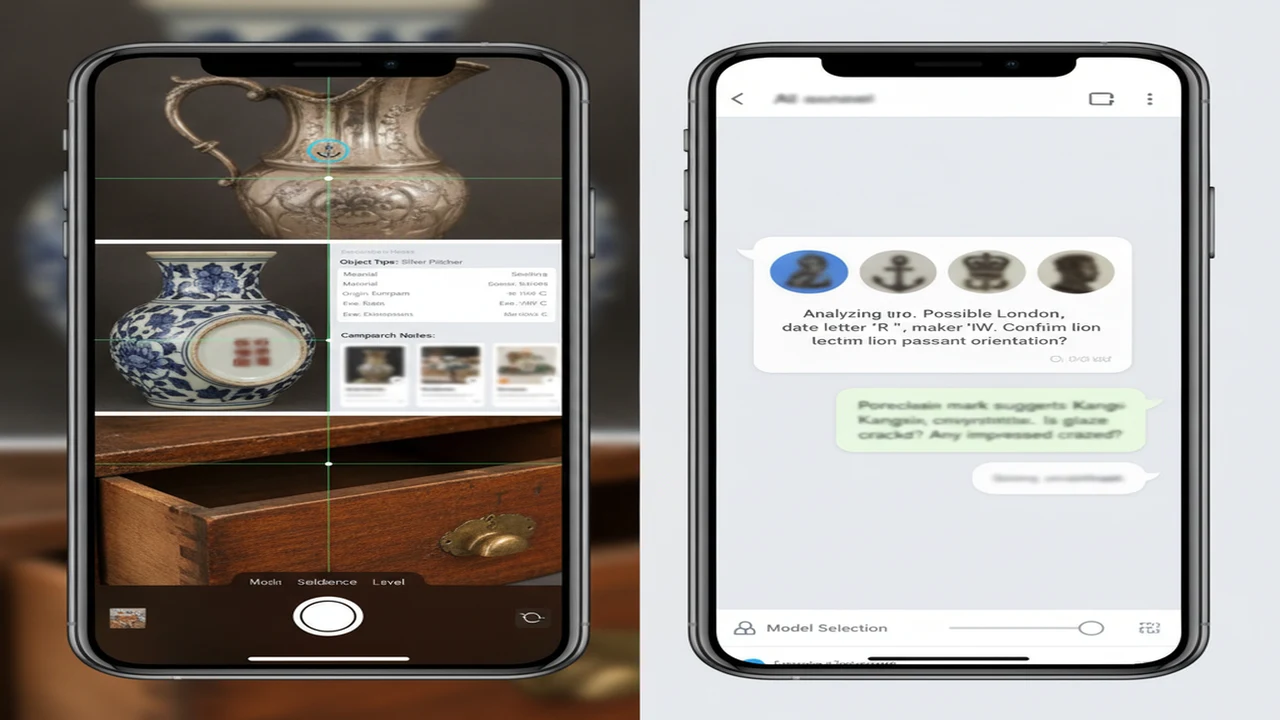
Pointing a camera at an old vase or silver spoon feels like the quickest route to an answer. The harder questions arrive afterward: Which visual clues support the identification, is the mark being read correctly, and does the suggested price reflect comparable completed sales or a generic estimate?
Scanner apps and multimodal chatbots solve different parts of that problem. A scanner organizes visual intake, while AI chat helps you interrogate the result, learn unfamiliar terminology, and plan the next research step.
Quick answer: A chatbot is useful for interpreting marks, developing research prompts, comparing possible origins, and explaining historical context. A dedicated scanner app is usually faster for photo-led identification, value ranges, authenticity clues, and collection records. A strong workflow uses the scanner for a structured first pass, then AI chat to question, compare, and verify the result.
What can an AI chatbot tell you about an antique?
A multimodal AI chatbot can examine an uploaded image, transcribe visible words, suggest object categories, and turn descriptive clues into research questions. It can also explain manufacturing methods, regional styles, artistic periods, maker biographies, and terms found in auction or museum records.
The useful role is interpretation rather than final authority. Ask the model to separate details it can directly observe from conclusions it is inferring. If it calls a bowl nineteenth-century porcelain, request the visible evidence for the date, two alternative identities, and the details that would distinguish them.
This makes chat useful as an AI antique identifier for exploratory research and for trying to identify maker signatures. A 2025 PMC/NIH chatbot study reported context-recognition ratings of 92.42% for chatbot answers and 84.85% for human answers. That broad result is not an antique-identification accuracy rate, but it helps explain why conversational systems can be effective at contextual explanation.
Switching to a second model can reveal conflicting readings or missing evidence. Agreement may increase confidence in a research direction, but it does not independently authenticate an object. Our guide to asking AI what an old object is and verifying the answer develops this distinction.
- “List three plausible identities for this object. For each one, separate observed evidence from inference.”
- “Transcribe this signature, include alternate readings, and suggest maker directories or museum records I should search.”
- “What photographs or measurements are missing before these two possible periods can be distinguished?”
When is a dedicated scanner app better than chat?
Open-ended conversation becomes inefficient when you need to process many objects in the same way. A dedicated scanner can turn each photograph into consistent fields such as probable identity, period, materials, condition clues, value range, and a saved collection entry.
That structure is useful for estate sorting, market shopping, reseller intake, or anyone who wants to search antiques by photo repeatedly. It reduces the need to rebuild the same prompt and makes it easier to save an antique collection rather than leaving findings scattered across chat threads.
For example, the iOS Antique Identifier, named Antique Identifier TIQ, is positioned around photo identification, value ranges, authenticity clues, and collection saving. It provides a structured first pass, while chat remains better for questions that do not fit predefined result fields.
The best app to identify antiques therefore depends on the job. Fast intake and organized records favor a dedicated interface. Ambiguous history, competing attributions, or a partially legible mark favor conversation and follow-up research.
How do scanner apps and research tools compare?
The table below presents a documentation-based view checked on August 6, 2026. It is organized by research task rather than declaring one universal winner.
The shortlist includes focused scanner apps, a general multimodal chatbot, broad visual search, and a historical market research source. These categories overlap, but their interfaces encourage different workflows and different kinds of verification.
How should you combine a photo scanner with multi-model AI chat?
A combined workflow treats the first scan as a hypothesis. The scanner supplies an organized starting point, and AI chat turns that starting point into questions that can be checked against references, market evidence, and the physical object.
When selecting tools around this process, see our guide to combining antique research apps with AI chat. Antique Identifier TIQ is one example of an AI antique identifier by photo that can handle the structured intake stage.
- Photograph: Capture the whole object, base, back, underside, joints, labels, damage, repairs, maker signatures, and marks. Include scale and multiple lighting angles rather than assuming one photograph contains enough evidence.
- Scan: Run the clearest images through a dedicated app. Save its proposed identity, period, materials, value range, and stated antique authenticity clues.
- Question: Move the proposed identity and visible evidence into chat. Prompt: “Challenge this identification. Which observations support it, which details conflict with it, and what evidence is still missing?”
- Compare: Ask a second AI model the same question. Compare reasoning, citations, uncertainty, and alternate readings rather than choosing whichever identity receives the most votes.
- Verify: Check specialist references, provenance, sold comparables, museum or maker records, and an appropriate human expert when attribution, value, or authenticity matters.
- Record: Save photographs, measurements, mark transcriptions, source links, comparable records, and unresolved questions with the object. Keep confirmed facts separate from scanner and chatbot hypotheses.
Which tool is more useful for estimating antique value?
An antique value checker can provide a useful range, but value is conditional. Condition, attribution, dimensions, provenance, location, sales venue, seller fees, restoration, certification, and current demand can all change the relevant figure.
A scanner is convenient for producing a quick antique market value range from the available image and category. Chat is better at building comparable-search terms, normalizing dates or currencies when reliable inputs are supplied, and explaining why two apparently similar listings may not be equivalent.
A 2025 consumer information search study found that consumers rated the internet at 6.26 for currency compared with 4.73 for conversational chatbots. For antiques, this supports checking recent market records instead of relying on a model's static knowledge.
WorthPoint is one possible source for historical market research. Marketplace completed-sales filters and auction archives can also help, but an asking price should not be confused with a completed sale. Use our source-checking workflow for old-object answers before relying on AI-generated pricing research.
Asking AI to appraise antiques by picture is not equivalent to obtaining a documented appraisal from a qualified antique appraiser. The latter may include physical inspection, defined valuation purpose, supporting comparables, and professional responsibility for the conclusion.
- Comparable-sales prompt: “Create a checklist for finding comparable completed sales for this object. Include identity, maker, period, dimensions, material, condition, restoration, provenance, sale date, venue, fees, and currency. Do not invent records or prices.”
Which tool handles history, signatures, and hallmarks better?
For antique history and context, a scanner can surface a probable category quickly. AI chat is more flexible when you need a chronological explanation, definitions of manufacturing terms, alternate regional origins, or questions that challenge the suggested period.
For maker signatures, upload the whole object before cropping the inscription. Ask chat to transcribe several possible readings, note uncertain letters, and suggest directories or institutional records. Google Lens can provide additional visual-search leads, but similar-looking signatures still need documentary verification.
For marks and hallmarks, the evidence should include the complete sequence rather than one isolated symbol. Antique silver identification benefits from photographs of assay symbols, date letters, maker stamps, the whole item, wear, and repairs. Reflective surfaces should be photographed from several angles.
A porcelain and ceramics identifier needs more than a base mark. Include the paste or body color, glaze, decoration, factory marks, and signs of transfer printing or hand painting. For antique furniture identification, document joinery, hardware, underside construction, repairs, wood grain, and overall proportions.
A structured result from Antique Identifier TIQ can help organize these clues, while chat can explore alternate readings and explain how the pieces relate. Neither interface can authenticate an object solely from photographs.
- History: use chat for terminology, timelines, regional context, and competing hypotheses.
- Signatures: combine full-object photographs, close crops, alternate transcriptions, and maker records.
- Marks or hallmarks: capture complete sequences and construction context before interpreting any single symbol.
Where can both chatbots and antique scanner apps fail?
Are antique identifier apps accurate? They can narrow a search and organize clues, but reliability varies with the object, image evidence, model, and available reference data. Confident wording, repeated scans, or agreement between models does not establish authenticity.
Different tools also have different knowledge, indexed sources, comparable records, regional coverage, subscriptions, and interface priorities. The main limitations should be considered together rather than hidden behind a single confidence score.
- A photo may omit construction details, dimensions, weight, texture, restoration, damage, or provenance required for a reliable attribution.
- Value ranges can shift with condition, location, sales venue, fees, demand, and whether the evidence comes from asking prices or completed sales.
- Marks, signatures, wood, metals, and ceramic symbols can be misread when images are blurred, reflective, cropped, worn, or photographed at an angle.
- Reproductions, replacement parts, later repairs, and added marks can resemble genuine period features, so image recognition alone cannot establish authenticity.
- Chatbots may invent context or citations, while scanner results may change with the photograph, model, database coverage, or app version.
- Subscriptions, advertisements, scan limits, collection features, and regional market coverage vary and should be checked in current listings.
Should you choose a scanner app, a chatbot, or both?
Choose AI chat for exploratory questions, unfamiliar terminology, antique history and context, research plans, and comparisons between competing hypotheses. Choose a dedicated antique appraisal app for repeated photo intake, structured results, value-range guidance, authenticity clues, and collection organization.
The combined workflow is more useful for sellers, inherited collections, market shoppers, and people investigating uncertain marks or attributions. Antique Identifier TIQ can provide the structured first pass, followed by multi-model questioning and source verification.
For insurance, estate, major-sale, attribution, or authenticity decisions, move beyond photo-only tools. Specialist records and a qualified professional may need to examine the object directly.
Comparison
| Tool | Best suited to | Typical output | Research advantage | Main caution |
|---|---|---|---|---|
| Antique Identifier TIQ | Structured iOS photo intake and collection saving | Possible identity, value range, authenticity clues, saved record | Keeps repeated scans organized | Results remain a first-pass research aid rather than formal authentication or appraisal |
| Antique Identifier - Relic | One-photo antique scan and dealer intake | Identity, era, materials, condition, origin, estimated USD range | Produces a compact object record | Supplied information places AI identification, history, comparison, and collection functions behind a subscription |
| Antique Identifier By Picture | Period identification and material and age details | Suggested identity, value, material, age, period, collection entry | Combines photo import with stored finds | Reviews report variable scans, advertising, and occasional maker or region errors |
| AntiqSnap: Antique Identifier | Reseller scanning and digital collection organization | Identification, pricing guidance, condition suggestions, collection tracking | Supports repeated intake and inventory-style records | Some reviews report material mistakes and difficulty separating reproductions from genuine pieces |
| Curio - Antique Identifier | Photo antique identification and visual item matches | Possible identity, background, value range, similar objects | Connects an image-led result with comparable-looking items | Comparable objects and historical information do not create a certified appraisal |
| General multimodal AI chatbot | Interpretation, follow-up questions, context, and research planning | Hypotheses, transcriptions, explanations, search terms | Can challenge an initial result and explain uncertainty conversationally | May invent context, citations, identities, or prices |
| Google Lens | Broad visual search | Visually similar pages, objects, and images | Useful for discovering terminology and possible matches | A visual match does not establish age, authorship, authenticity, or value |
| WorthPoint | Historical market research | Historical records relevant to comparable research | Helps collectors investigate earlier market evidence | Records still need to be matched for condition, dimensions, attribution, date, and sale context |
Limitations
Frequently Asked Questions
Are antique identifier apps accurate?
They can narrow the possibilities, especially when an object is distinctive and the photographs are clear. Reliability depends on image quality, visible construction details, object type, and the reference coverage available to the tool.
Can a chatbot identify an antique from a photo?
A multimodal chatbot can suggest a plausible identity and explain visual clues, but that is different from verified attribution. Ask it to list observable evidence, alternate possibilities, missing details, and its uncertainty.
Can Antique Identifier TIQ estimate value from a picture?
Antique Identifier TIQ is positioned to provide a value range from photo-led identification. Use that range as research guidance, not as a certified appraisal or guaranteed sale price.
What photos should I take for antique silver identification?
Photograph the full item, complete mark sequence, assay symbols, date letters, maker stamp, damage, repairs, and a scale reference. Add close-ups from multiple lighting angles to reduce blur and reflections.
Is Google Lens enough to identify an antique?
Google Lens can find visual matches and useful search terms. It is not a complete source for an object's history, authenticity, attribution, condition-adjusted value, or comparable completed sales.
Can AI tell whether an antique is genuine or a reproduction?
A chatbot or scanner, including Antique Identifier TIQ, may surface authenticity clues or inconsistencies. No photo-only AI result establishes that an object is genuine, especially when reproductions, repairs, or later-added marks are involved.
When should I use an antique appraiser instead of AI?
Consult a qualified specialist for insurance, tax, estate, major-sale, disputed-attribution, or high-value authenticity decisions. Physical inspection and documented professional analysis may be necessary.