
Best Rock Identifier Apps in 2026
Quick answer: AI Rock ID is the best rock identifier app for most iPhone users because it gives five free photo scans daily and lists its prices plainly. Rock Identifier: Stone ID is better for Android support, older iPhones, and a 6,000-type catalog. Pick Rockd when you need field geology maps instead of photo identification.
You find a striped stone beside a trail, take a photo, and get three different answers. Welcome to rock identification by phone.
The best apps give you a useful starting point, mineral properties, and enough free scans to compare photos. They can't measure hardness, streak, or density through a camera, so valuable or unusual specimens still need hands-on checks.
We ranked these picks for someone who wants a rock identifier app now, with prices and store details checked in October 2026.
Comparison at a glance
| App | Best for | Platforms | Free version | Price | Standout |
|---|---|---|---|---|---|
| AI Rock ID | Most iPhone users | iPhone and iPad | Five photo scans per day | October 2026: $4.99 weekly or $29.99 yearly | Rock, crystal, fossil, and value results in one scan |
| Rock Identifier: Stone ID | Large catalog and Android support | iPhone, iPad, and Android | Free version; exact scan limits unknown | October 2026: listed purchases range from $3.99 to $69.99 | Catalog covering more than 6,000 types |
| Rock & Crystal Identifier | Crystal collectors who also shop | iPhone, iPad, and Android | Free use; exact scan allowance unknown | October 2026: $1.99 weekly, $5.99 monthly, or $29.99 yearly | Identification, collection records, and crystal filters |
| Crystalyze | Spiritual crystal guides | iPhone and iPad | Free app; identifier limit unknown | October 2026: listed purchases range from $2.99 to $34.99 | Crystal ID plus chakra, zodiac, and moon tools |
| Crystal Identifier | Scanning a crystal in a browser | Web | One free scan per day | October 2026: check the site for paid terms | No-account crystal scan from an uploaded photo |
| AllScan AI | Identifying rocks and other objects | Web; iPhone and Android named on its site | One free web scan stated; mobile limits unknown | October 2026: check the listing | One scanner for rocks, plants, coins, and more |
| Rockd | Field geology and maps | iPhone and iPad | All listed functions are free | October 2026: Free | More than 290 geologic maps |
| Mindat | Manual mineral research | Web | Public website access | October 2026: check the site for account terms | Mineral database for checking a possible ID |
Prices and ratings from the US App Store and Google Play, checked October 2026. Store prices change; the listing is the final word.
How we picked
We read the supplied US App Store listings, official developer sites, and available pricing details in October 2026. We also used the supplied Google Play research where it confirmed Android availability. Unknown prices and free limits stay marked as unknown.
The order favors fast specimen identification, usable free access, price clarity, and useful geology details. Store ratings show audience size, not identification accuracy. We found no controlled test that proves one app identifies every specimen more accurately.
- The app can identify rocks or minerals from a photo.
- The free limit is stated and usable.
- Results include properties that help you check the answer.
- Prices and device requirements are easy to find.
- Collections, maps, or reference records add a real second use.

AI Rock ID
4.6 on the App Store (576 ratings)
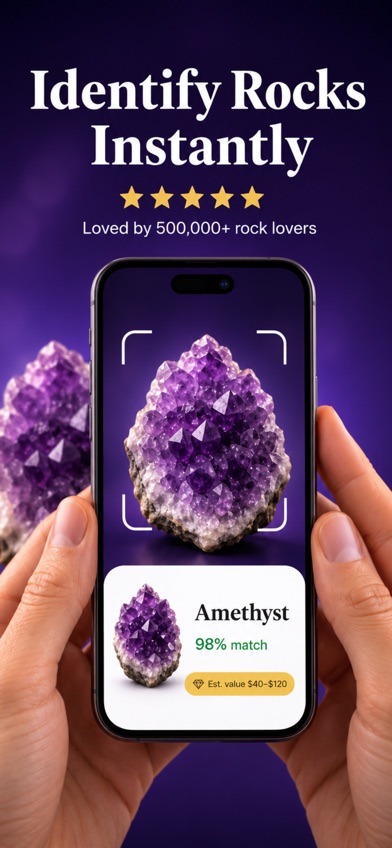
AI Rock ID is our first pick because it gives iPhone users five free photo scans each day. That known allowance is more useful than a vague free download followed by an unknown paywall. The app covers rocks, crystals, minerals, gemstones, fossils, and common look-alikes.
A result can include the likely name, rock type, Mohs hardness, formation details, rarity, and an estimated value range. You can also save finds in a collection. That combination fits someone sorting beach finds or a mixed box of specimens, though any value estimate needs confirmation before you buy, sell, or insure something.
The US App Store showed 4.6 stars from 576 ratings and an August 3, 2026 update. That's a much smaller rating count than Rock Identifier: Stone ID, but the transparent five-scan limit and stated subscription prices fit this search better. The catch is device support: AI Rock ID needs iOS 18.0 or later, and Android isn't listed.
- Five free scans each day
- Covers fossils and gemstones too
- Saved collections and value ranges
- Requires iOS 18.0 or later
- Paid access follows the daily allowance
- Price
- October 2026: Free download; $4.99 weekly or $29.99 yearly.
- Platforms
- iPhone and iPad.
Pick AI Rock ID if you want a focused iPhone scanner with a known daily free allowance.

Rock Identifier: Stone ID
4.7 on the App Store (81,888 ratings)
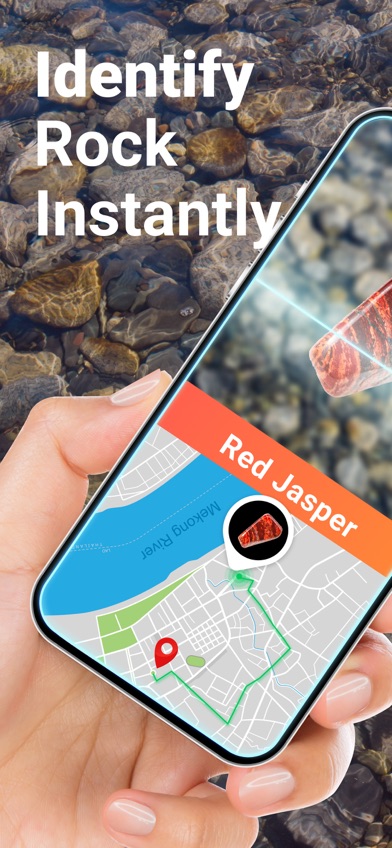
Rock Identifier: Stone ID is the veteran of this list. Its listing says the photo scanner recognizes more than 6,000 rocks and minerals, then gives details such as formula, hardness, color variations, and common locations. It also has identification history and collection tools.
Its biggest advantage is reach. The US App Store showed 4.65 stars from 81,888 ratings, 14 languages, and a September 23, 2026 update. It runs on iOS 15.0 or later, so it supports older iPhones than AI Rock ID. Android availability is also confirmed in the supplied research.
The pricing is the messy part. A free version exists, but the exact scan, ad, and watermark limits weren't available. The App Store listed purchases from $3.99 through $69.99 under the same premium name, so check the checkout screen before accepting a trial or subscription. The huge rating count proves a larger store audience, not better identification.
- More than 6,000 listed types
- Works on Android
- Supports 14 languages
- Free scan limits are unknown
- Current subscription structure is unclear
- Price
- October 2026: Free download; listed purchases range from $3.99 to $69.99. Check the listing.
- Platforms
- iPhone, iPad, and Android.
Pick Rock Identifier: Stone ID if you use Android or need support for an iPhone below iOS 18.
Rock & Crystal Identifier (Crystal Council)
4.6 on the App Store (2,779 ratings)
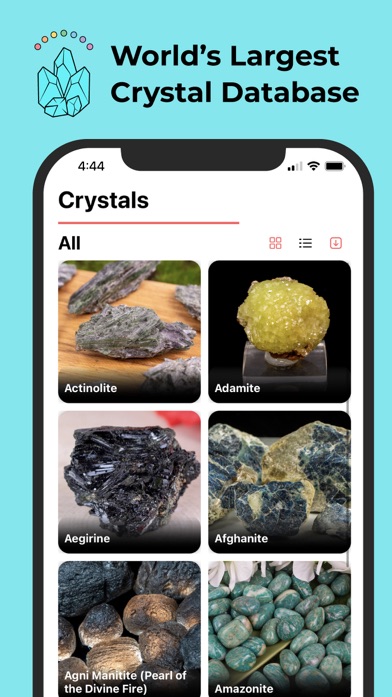
Rock & Crystal Identifier scans uploaded photos and connects the result to a catalog said to contain more than 6,000 rock and crystal specimens. It records scan history, photos, notes, and collection categories, which is useful when your shelf has outgrown handwritten labels.
This app leans heavily toward crystals. You can filter information by color, chakra, planet, emotion, and other spiritual categories, then browse similar specimens in its store. Some buyers will like that direct path. Anyone seeking geology alone may find the spiritual and shopping sections less relevant than AI Rock ID's rock and fossil coverage.
The US App Store showed 4.57 stars from 2,779 ratings and a September 18, 2026 update. It needs iOS 15.6 or later, and Android availability is confirmed by the supplied research. The listing says free use needs no trial or signup, but it doesn't state the regular free scan allowance. Paid prices are much easier to read.
- Catalog of more than 6,000 specimens
- Collection notes and scan history
- Android support
- Free scan allowance is unknown
- Heavy focus on spiritual filters and shopping
- Price
- October 2026: $1.99 weekly, $5.99 monthly, or $29.99 yearly.
- Platforms
- iPhone, iPad, and Android.
Pick Rock & Crystal Identifier if you want photo ID, collection records, and crystal shopping in the same app.

Crystalyze
4.8 on the App Store (3,422 ratings)
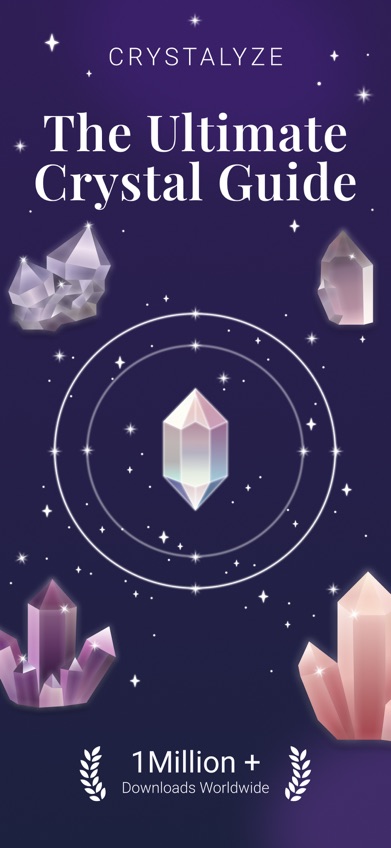
Crystalyze is a crystal-first app with photo identification added to a broader spiritual guide. Its reference section covers more than 175 crystals, with filters for chakra, zodiac sign, planet, element, and metaphysical use. There is also a moon calendar and a private journal.
Premium adds unlimited identification, permanent scan history, personal photos, and own, favorite, or wishlist collections. This is a strong match if identifying a stone is the first step in meditation or energy work. For rockhounding, the catalog is narrower and less geology-focused than the 6,000-type listings claimed by the two picks above.
Crystalyze had the highest App Store score here: 4.75 stars from 3,422 ratings, checked October 2026. It was updated October 6, 2026 and needs iOS 15.0 or later. The exact free identifier allowance wasn't stated. Several monthly and annual prices appeared in the listing, so check which term appears on your device.
- High 4.75 App Store rating
- Crystal collections and private notes
- Moon, chakra, and zodiac guides
- Less focused on field geology
- Free scan limit is unknown
- Price
- October 2026: Free download; listed purchases range from $2.99 to $34.99. Check the listing.
- Platforms
- iPhone and iPad.
Pick Crystalyze if spiritual crystal information is as important to you as the photo result.
Crystal Identifier
Crystal Identifier is a web scanner for crystals, stones, and minerals. You upload a JPG, PNG, WebP, or HEIC photo and get a likely specimen name with details such as crystal system, Mohs hardness, formation type, and an estimated value. No account is required for the basic scan.
The site states that rough points, clusters, tumbled stones, and raw specimens are supported. Its best use is quick crystal research when you don't want to install an app. The one-free-scan-per-day limit also makes it a genuine rock identifier free option for occasional use, though AI Rock ID gives iPhone users more daily attempts.
There is no supplied US App Store or Google Play rating for this separate browser tool, and no controlled accuracy result was provided. The site itself says photo identification can't measure hardness, specific gravity, or refractive index. That is an honest limit. Use the result as a candidate, then compare physical properties before spending money on a specimen.
- Works in a web browser
- No account needed
- Handles several image formats
- Only one free scan per day
- No supplied mobile store rating
- Price
- October 2026: One free daily scan; check the site for paid terms.
- Platforms
- Web.
Pick Crystal Identifier if you need one quick crystal scan without installing an app.
AllScan AI
AllScan AI is a general image scanner that includes rocks among many supported subjects. The same tool is meant to recognize plants, animals, insects, coins, food, products, antiques, and other objects. That range is handy when your camera roll contains more than quartz and granite.
For a rock, AllScan AI returns a likely answer with context from the uploaded photo. Its main advantage is convenience: you don't need separate scanners for a trail find, houseplant, and old coin. The trade-off is specialization. The supplied site information doesn't confirm the same mineral-property depth, specimen catalog, or collection tools found in the dedicated rock apps above.
The web page displayed one free scan and named iPhone and Android mobile options, but supplied US store listings, ratings, update dates, and current mobile prices weren't available. Check the mobile listing before subscribing. I'd use AllScan AI for quick curiosity scans, then confirm any mineral result with a focused database or physical tests.
- Scans many object categories
- Web access is available
- Useful beyond rock collecting
- Less specialized for geology
- Mobile prices and limits are unknown
- Price
- October 2026: One free web scan stated; check the mobile listing.
- Platforms
- Web; iPhone and Android are named on its site.
Pick AllScan AI if you want one image scanner for rocks, plants, coins, and household objects.

Rockd
4.4 on the App Store (187 ratings)
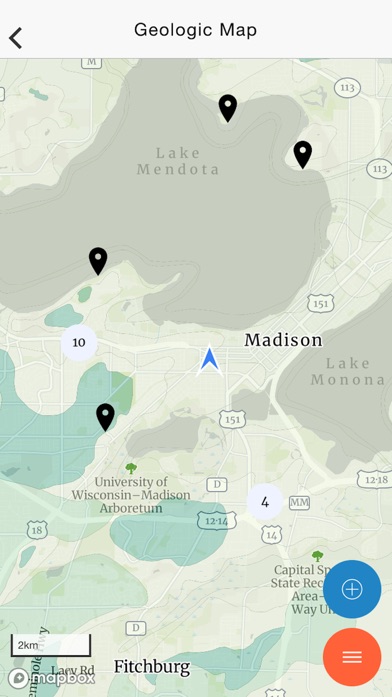
Rockd isn't a photo rock identifier. It tells you about the geology around your current location and lets you record field observations. The app has more than 290 geologic maps, a 3D globe, altitude data, paleogeographic views, and map caching for areas with weak service.
That makes Rockd the better download for a geology trip. You can save observations offline, record strike and dip, connect notes to mapped units, and inspect available stratigraphic columns or published literature. A camera scanner may guess what is in your hand; Rockd helps explain the formation beneath your feet.
Rockd was free on the US App Store, with no listed in-app purchases. It had 4.38 stars from 187 ratings and was updated June 12, 2026. It needs iOS 16.6 or later. Skip it if you only want an instant specimen name, but keep it beside a scanner if location and geologic context are part of the fun.
- More than 290 geologic maps
- Offline field observations
- No listed subscription
- No photo specimen identification
- Requires iOS 16.6 or later
- Price
- October 2026: Free.
- Platforms
- iPhone and iPad.
Pick Rockd if you care more about field maps and local geology than a camera-based answer.
Mindat
Mindat is a web mineral database, not a one-tap camera scanner. That puts it last for someone searching for instant identification, but it can be more useful after another app gives you a possible name. Search that candidate and compare the available mineral record with your specimen.
Mindat suits collectors who want manual research and can work through mineral terminology. It also avoids the false certainty of a single photo answer: you remain responsible for comparing color, crystal form, hardness, streak, location, and associated minerals. That takes longer, but unusual or mixed specimens often need more than image recognition.
The supplied material didn't include an App Store or Google Play listing, store rating, mobile update date, or subscription table for Mindat. Use it through the web, and check the site for current account terms. Mindat is a strong second stop for research; it isn't the download to choose when you want to point a phone at a rock and receive an immediate result.
- Focused mineral reference database
- Useful for checking app results
- Works through a web browser
- No instant photo identification
- No supplied mobile store data
- Price
- October 2026: Public web access; check the site for current account terms.
- Platforms
- Web.
Pick Mindat if you already have a possible mineral name and want to research it in more depth.
AI Rock ID vs Rock Identifier: Stone ID
These are the closest matches for a general-purpose rock identifier app. AI Rock ID ranks first for transparent free access and pricing; Rock Identifier: Stone ID has the larger store audience, broader device support, and an older catalog.
| Point | AI Rock ID | Rival |
|---|---|---|
| Free identification | AI Rock ID states five free scans per day. | Rock Identifier: Stone ID has a free version, but its exact scan limit is unknown. |
| Paid price | AI Rock ID lists $4.99 weekly and $29.99 yearly. | Listed purchases range from $3.99 to $69.99; check the current plan. |
| Device support | AI Rock ID needs iOS 18.0 and has no listed Android version. | Rock Identifier: Stone ID supports iOS 15.0 and Android. |
| Store record | AI Rock ID has 4.6 stars from 576 US App Store ratings. | Rock Identifier: Stone ID has 4.65 stars from 81,888 US App Store ratings. |
| Result focus | AI Rock ID covers rocks, crystals, fossils, gemstones, saved finds, and value ranges. | Rock Identifier: Stone ID centers on a catalog of more than 6,000 rocks and minerals. |
Choose AI Rock ID when you want several free attempts every day and don't want to decode the subscription before scanning. Five attempts also let you photograph another surface when the first result looks wrong.
Rock Identifier: Stone ID wins for Android users, older iPhones, language support, and sheer rating volume. Its unclear free limits and crowded purchase list keep it in second place.
What to check before downloading a rock identifier
Treat photo results as candidates
No controlled benchmark in the supplied research proves which app is most accurate. A photo can't measure streak, hardness, density, magnetism, or acid reaction. Look for an app that gives mineral properties and possible look-alikes, then compare those details yourself. If the result changes between photos, don't pick the answer you like best.
Read the free limit and renewal price
Free can mean five daily scans, one scan, a short trial, or a download that blocks identification. Check the allowance, renewal period, and cancellation screen before subscribing. A weekly plan gets expensive fast if you only identify a few vacation finds each year. Known limits are easier to compare than a generic free label.
Match the tool to the trip
A dedicated photo scanner fits a box of unlabeled specimens. Rockd is more useful when you need local formations, cached maps, and field notes. A web database fits careful follow-up at home. Also check the required iOS version, Android availability, internet needs, and whether you can use the app without creating an account.
Check the result details and collection tools
A name alone isn't enough for verification. Useful records include hardness, formula, crystal form, formation, location, photos, and personal notes. Collection history is worth paying for if you catalog dozens of finds. For one mystery stone, a recurring plan probably isn't worth it. Never rely on an app alone for authenticity or a valuable sale.
Frequently asked questions
Which rock identifier app is most accurate?
No controlled accuracy comparison was available in October 2026. AI Rock ID ranks first here for its known free allowance and useful result details, not a proven accuracy score.
Is there a rock identifier free option without a trial?
AI Rock ID gives five free scans per day, while Crystal Identifier states one free browser scan per day. Check the current listing because free limits can change.
Are rock identifier apps actually reliable?
Rock identifier apps can suggest a likely name, but they can also return confident and inconsistent errors. Confirm the result with hardness, streak, density, location, and reference records.
Why does a rock identifier give different answers for the same rock?
Lighting, camera angle, weathered surfaces, reflections, and mixed minerals can change what the software sees. Photograph several clean surfaces in natural light and compare the repeated candidates.
Can an app identify polished stones or rocks with several minerals?
Polished surfaces and mixed rocks are harder because they can hide grain, cleavage, and natural texture. Use multiple views and seek expert identification for valuable or unusual specimens.
What is the best rock app for geologic maps?
Rockd is the best fit here for geologic maps, offline field observations, altitude data, and local formation context. Rockd doesn't identify a hand specimen from a photo.
What is the best website for checking a mineral identification?
Mindat is the best fit in this list for manual mineral research after you have a possible name. Mindat is a web database, not an instant camera scanner.
Our pick for most rock photos
Download AI Rock ID if you have a compatible iPhone and want a focused scanner with five free attempts each day. Choose Rock Identifier: Stone ID for Android or an older iPhone, Rockd for field maps, and Crystalyze when spiritual crystal guides are the main attraction.
AI Rock ID is best for several free daily scans
AI Rock ID's strongest advantage is simple and checkable: five free photo scans per day. That's enough to scan several finds or retry the same specimen from different angles before paying. Results can cover rocks, crystals, minerals, gemstones, fossils, and estimated value ranges.
It's worth trying if you use an iPhone or iPad on iOS 18.0 or later and want one focused collection app. Android users and owners of older iPhones should pick Rock Identifier: Stone ID instead.